
Asantehene urges legal practitioners to deepen knowledge of chieftaincy law

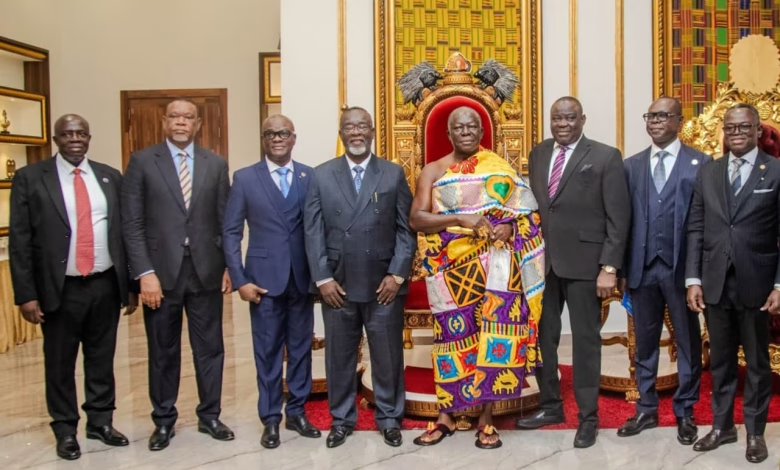
Image credit: Ghana Business News.
- Otumfuo Osei Tutu II urged judges and lawyers to be well versed in chieftaincy law.
- The Asantehene cited Article 270 of the 1992 Constitution in discussing protections for chieftaincy.
- He spoke at a Kumasi lecture marking the Supreme Court of Ghana’s 150th anniversary.
The Asantehene, Otumfuo Osei Tutu II, has urged members of Ghana’s Bench and Bar to develop a strong understanding of the laws governing the chieftaincy institution.
Speaking in Kumasi at a lecture commemorating the 150th anniversary of the Supreme Court of Ghana, the Asantehene said the 1992 Constitution provides clear protection for chieftaincy and the Traditional Councils established under customary law.
The lecture was held under the theme, “The Supreme Court and the Institution of Chieftaincy: The Past, Present and Future.”
Referencing Article 270 of the Constitution, Otumfuo Osei Tutu II said Parliament was barred from making laws that would detract from the honour and dignity of chieftaincy. He said this constitutional position should be understood particularly by judges and lawyers who may not be closely familiar with chieftaincy law.
According to the Asantehene, chieftaincy is not simply accommodated within Ghana’s constitutional system but is entrenched as part of the country’s governance structure.
He traced the historical role of chiefs as leaders involved in governance, justice, land custodianship and social order before the introduction of the colonial court system. In that period, he said, disputes were addressed through customary processes that placed emphasis on reconciliation and communal harmony.
The Asantehene said colonial rule introduced English common law and a parallel authority structure, with the Supreme Court becoming the apex court within that system. He said the relationship between the legal system and chieftaincy had at times been difficult, including periods in which the judicial roles of chiefs were restricted.
He further recalled that, after independence, successive constitutional arrangements had grappled with the place of chieftaincy in a modern state. He said there had been instances of legislation affecting recognition of persons installed under customary law.
Otumfuo Osei Tutu II said chieftaincy had endured because of the legitimacy it commands within communities. He expressed the hope that the work of Traditional Councils and the Judicial Committees of the Houses of Chiefs would continue to clarify the relationship between customary institutions and the formal judicial system.