Legal series traces Ghana’s tribunal system from military rule to judicial integration

- The article traces tribunal developments in Ghana from 1979 to 1993.
- It says public tribunals operated separately from the regular courts during the PNDC era.
- The 1992 Constitution is described as ending the parallel public tribunal system.
- Act 459 integrated tribunal structures into the broader judicial framework.
A legal history series published by MyJoyOnline has traced the changing role of tribunals in Ghana’s justice system from the Armed Forces Revolutionary Council era in 1979 through the adoption of the 1992 Constitution and the Courts Act, 1993.
The first instalment of The Law 101 describes a progression from special courts operating outside the regular judicial structure to a system intended to place adjudicating bodies under unified judicial oversight.
Special courts under military rule
According to the article, the AFRC established special courts through the Armed Forces Revolutionary Council (Special Courts) Decree, 1979, to deal with specified criminal offences. The article cites Justice Stephen Alan Brobbey’s account that little was publicly known about the membership, operations or procedures of those courts, whose decisions were final and not subject to appeal.
It says the 1979 Constitution, which ushered in the Third Republic, sought to restore the ordinary court hierarchy while allowing a special tribunal created under AFRCD 23 to complete outstanding cases. The period is described as one in which the special tribunal structure was being wound down.
Parallel public tribunals
The article identifies the PNDC period as the most significant expansion of tribunals. Under the Public Tribunals Law, 1982, it says, Ghana operated a four-level system comprising National, Regional, District and Community Public Tribunals.
These bodies operated alongside the ordinary courts rather than within the same appellate framework. Citing Justice Brobbey, the article says the two systems were distinct institutions and that appeals or reviews could not move between them.
The series says the arrangement attracted sharply differing views. It notes that supporters valued speed and public participation, while legal practitioners and human-rights advocates raised concerns about institutional independence and due-process safeguards.
Integration under the Fourth Republic
The 1992 Constitution marked a reversal of the parallel model, the article says. It cites constitutional provisions which abolished public tribunals while retaining the Supreme Court, Court of Appeal and High Court, and creating Regional Tribunals.
Under the Courts Act, 1993, or Act 459, Regional Tribunals were placed at the High Court level for certain criminal matters. The article says Circuit Tribunals and Community Tribunals were also established, with Community Tribunals serving as the lowest level of court and dealing with civil and criminal cases.
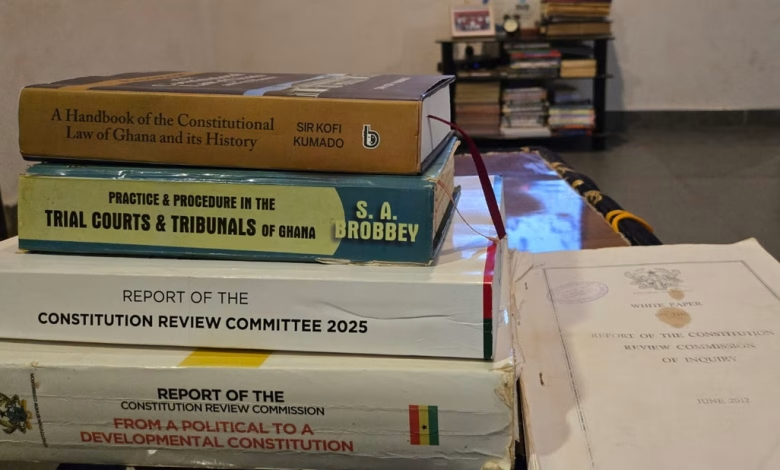
The account characterises the 1993 framework as a constitutional compromise: it ended the separate tribunal structure but retained elements of citizen participation in justice administration. The series draws on works by Justice Brobbey and constitutional scholar Sir Kofi Kumado, and says a second part will follow.