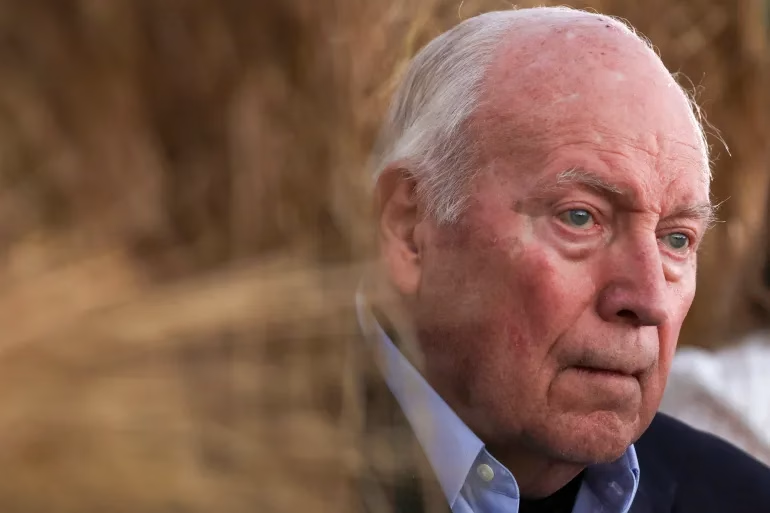
Dick Cheney, the most powerful U.S. vice president in modern history and a principal force behind America’s post-9/11 “war on terror,” has died at the age of 84, his family announced.
“His beloved wife of 61 years, Lynne, his daughters Liz and Mary, and other family members were with him as he passed,” the family said in a statement, noting that he died from complications of pneumonia and cardiac and vascular disease.
“Dick Cheney was a great and good man who taught his children and grandchildren to love our country and to live lives of courage, honor, love, kindness, and fly-fishing,” the statement continued. “We are deeply grateful for all he did for our nation and blessed beyond measure to have loved—and been loved by—this noble giant of a man.”

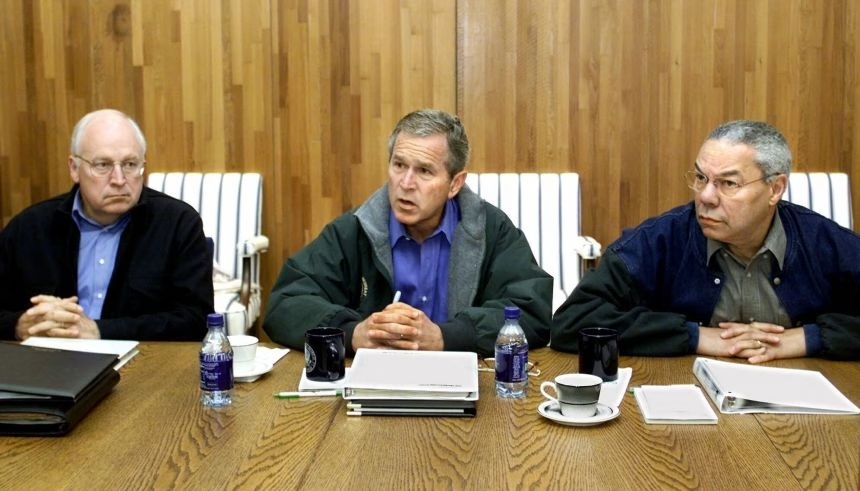
Serving as the 46th vice president under George W. Bush from 2001 to 2009, Cheney was a dominant and polarizing figure in Washington for decades. Though he remained a staunch conservative until the end, he grew estranged from much of his party over his fierce opposition to Donald Trump, whom he labeled “a coward” and “the greatest threat ever to our republic.”
In a symbolic end to his political journey, Cheney’s final presidential vote in 2024 went to Democrat Kamala Harris—a striking reflection of how far the modern GOP had drifted from his brand of traditional conservatism.
Plagued by heart disease for most of his life, Cheney survived multiple heart attacks and underwent a heart transplant in 2012, which he later described as “the gift of life itself.”
A former Wyoming congressman, White House chief of staff, and defense secretary, Cheney was enjoying a lucrative private-sector career when George W. Bush tapped him to vet potential running mates for the 2000 ticket. The search ended with Cheney selecting himself, becoming the seasoned counterpart to a relatively inexperienced new president.
Although often caricatured as the true power behind the Bush presidency, Cheney’s influence was nonetheless immense.
He was in the White House on the morning of September 11, 2001, when hijacked planes struck the World Trade Center. In that instant, he later said, he became a changed man—determined to prevent another such attack and to project U.S. power across the Middle East through a policy of pre-emptive action and regime change.
From a bunker beneath the White House, Cheney directed the government’s crisis response, even authorizing the military to shoot down hijacked aircraft bound for Washington. His frequent relocations to “undisclosed locations” reinforced his image as the shadowy commander of a secret war.
Cheney soon pressed for expanding the U.S. military campaign beyond Afghanistan to Iraq, alleging that Saddam Hussein possessed weapons of mass destruction and maintained links to al Qaeda. Those claims—later discredited—helped pave the way for the 2003 invasion. Subsequent investigations revealed that the intelligence was deeply flawed and, in some cases, misrepresented. Cheney, however, insisted that he and other officials had relied on “the best available intelligence” and dismissed accusations of deliberate distortion as “utterly false.”
He also defended the use of “enhanced interrogation techniques,” which critics condemned as torture, and the detention of suspects at Guantánamo Bay. To the end, he expressed no regrets about these policies, asserting, “I would do it again in a minute.”
By the time he left office, Cheney’s approval rating had fallen to 31%, and he was widely seen as a symbol of the moral and strategic excesses of the war on terror. Yet he remained unrepentant, convinced he had acted to protect the nation.
In later years, Cheney became one of the most prominent Republican critics of Donald Trump, condemning his attempt to overturn the 2020 election and his role in the January 6th insurrection. His daughter, Rep. Liz Cheney, followed suit—sacrificing her own political career in defense of democratic principles.
In a 2022 campaign ad supporting his daughter, the elder Cheney appeared wearing a cowboy hat and delivered a blunt message: “In our nation’s 246-year history, there has never been an individual who is a greater threat to our republic than Donald Trump. He is a coward.”
Early Life and Career
Richard Bruce Cheney was born on January 30, 1941, in Lincoln, Nebraska, and raised in Casper, Wyoming, where he met his high-school sweetheart, Lynne Vincent. After struggling at Yale and leaving the university, Cheney worked on power lines and was twice arrested for driving under the influence before deciding to turn his life around. He earned bachelor’s and master’s degrees in political science from the University of Wyoming, marrying Lynne in 1964.
Cheney’s Washington career began during the Nixon administration and rose swiftly under President Gerald Ford, for whom he served as chief of staff. He later represented Wyoming in Congress for six terms, becoming House minority whip, and was appointed secretary of defense by President George H.W. Bush in 1989, overseeing the Gulf War.
Cheney is survived by his wife, Lynne, their daughters Liz and Mary, and seven grandchildren.