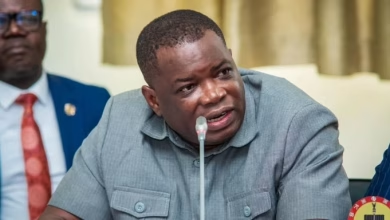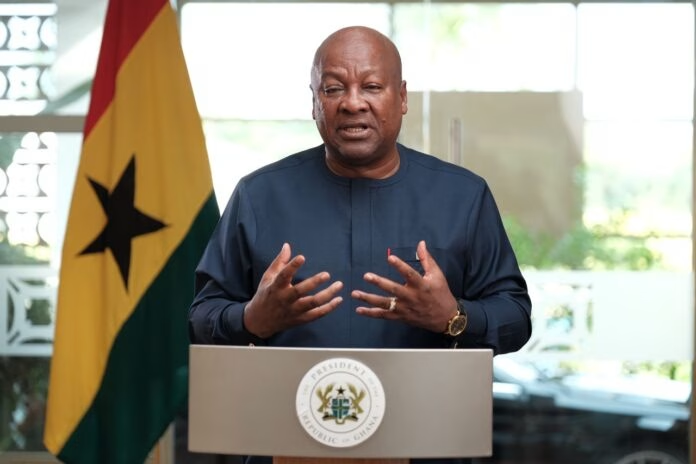
President John Dramani Mahama will lead high-level discussions on the Accra Reset in Davos, Switzerland, on the sidelines of the World Economic Forum (WEF) Annual Meeting on January 22, 2026. The engagement marks the initiative’s first appearance at Davos and signals a major milestone for the Global South–led effort focused on strengthening sovereign capacity and redefining international cooperation in the face of mounting global challenges.
President Mahama chairs the Presidential Council of the Accra Reset, a body comprising current and former world leaders committed to advancing reforms aimed at creating a fairer and more effective global system.
Expected to participate in the side event are Egyptian President Abdel Fattah El-Sisi, Kenyan President William Samoei Ruto, and President Félix Tshisekedi of the Democratic Republic of Congo. Nigeria will be represented by Vice President Kashim Shettima, while Papua New Guinea will be represented by Prime Minister James Marape.
Also taking part are former heads of state who form the Guardians Circle of the Accra Reset, including former Nigerian President Olusegun Obasanjo, former New Zealand Prime Minister Rt. Hon. Helen Clark, former Mauritian President Ameenah Gurib-Fakim, and former Liberian President Ellen Johnson-Sirleaf. The Davos meeting is expected to unveil priority programmes following the initiative’s launch at the 2025 United Nations General Assembly and its endorsement at the G20 Leaders’ Summit in Johannesburg.
The Presidency notes that the Accra Reset comes at a pivotal moment, as the world faces escalating great-power rivalries, weakening global aid structures, rising trade tensions, and overlapping crises such as climate shocks, cost-of-living pressures, pandemics, and armed conflicts.
President Mahama has positioned the Accra Reset as complementary to his domestic reform drive, the Resetting Ghana Agenda, emphasizing that effective national governance depends on both robust internal reforms and a more just international system.
He has repeatedly stressed that sovereignty must empower nations to pursue their development visions while fostering strategic partnerships—particularly within Africa and across the Global South—to advance shared priorities and collective interests.