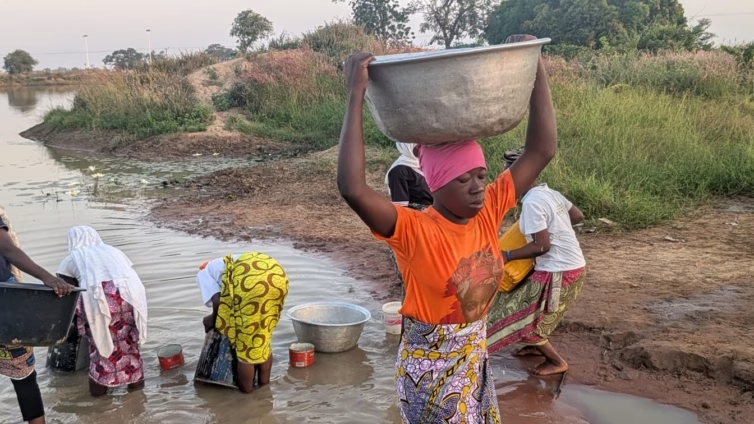
For more than three decades, the people of Nanton Zuo in northern Ghana have lived with a devastating reality: their only drinking water source is slowly poisoning them.
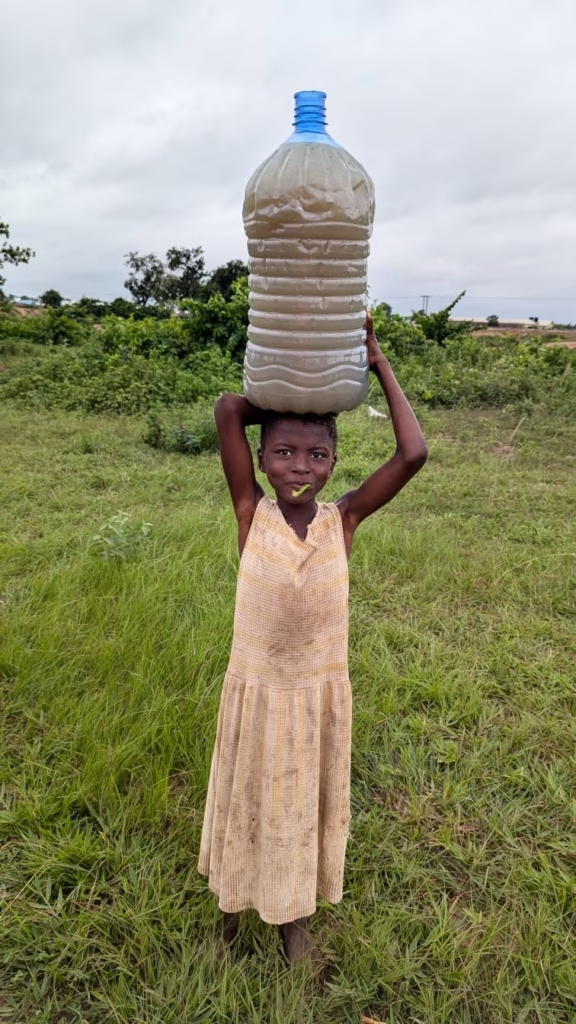
Over 5,000 residents — including children, farmers, pregnant women, and the elderly — depend on a heavily polluted dam contaminated with human waste, animal droppings, agrochemicals, and thick mud. The water is brown, foul-smelling, and unsafe, yet it is their only option. Health workers call it a silent emergency.
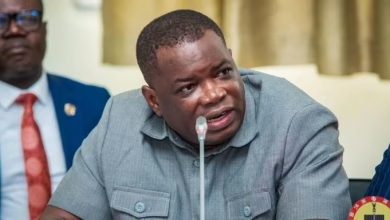
“We are dying quietly. We don’t need sympathy — we need action,” community leader Fuseini Salifu told JoyNews.
A JoyNews investigation, “Poisoned Water – Paying Dearly for a Basic Necessity,” revealed alarming laboratory findings: extremely high concentrations of E. coli and Salmonella, bacteria that cause diarrhoea, kidney problems, typhoid, and severe infections.
Senior Urologist Dr. Akis Afoko issued a stark warning: “The community risks dying from within if nothing changes. The water is toxic, but people drink it because they have no alternative.”
Since the investigation, conditions have only worsened. Cases of diarrhoea, typhoid, skin infections, and other illnesses have increased.
Teachers report that many children miss early lessons because they spend their mornings fetching water, especially during the dry season. Parents say they are raising their children “in survival mode.”
AME Zion Church’s Northern Regional Manager, Ransford Kwabena Bayisi, said school attendance drops drastically. “Some days, nearly half of the class is absent — sick or searching for water.”
A Growing Community Without a Water System
Nanton Zuo began as five small villages but has now expanded into a large settlement — with no proper water system.
The dam has never been protected, treated, or expanded. Farmlands are drying up, young people are migrating to cities for menial jobs, and frustration is driving some toward petty theft.
Almost every household suffers from water-related illnesses, yet the community has no public health centre. Residents travel 10–15 km for medical care or resort to private facilities that don’t treat common diseases. As a result, more than 80% rely on self-medication and often take incomplete doses of antibiotics.
Families spend ₵200–₵450 monthly on medication — a heavy financial toll for a farming community. During diarrhoea outbreaks, cases surge, although no official data is available.
Sachet water is the only safe option, but a family of six spends ₵360–₵540 a month. Many must choose between clean water and food.
Women and girls are hit hardest, walking up to 5 km and spending hours fetching water during the dry season. School absenteeism increases by up to 38%, and girls miss several school days each month.

Why Boreholes Keep Failing
Partner organisations have drilled more than 15 boreholes — all unsuccessful.
Water engineer Fadlu Rahman Mashod explains that the underground rock formation — mainly mudstone and shale — cannot store groundwater.
He says successful drilling would require advanced studies and deeper exploration, which may still fail.
As a result, families now buy water from private suppliers for ₵3.50–₵5.00 per 25 litres. Most households cannot afford this, but with government support, the price could drop significantly.
Experts recommend three practical solutions:
- A community water treatment plant
- Deep, high-yield boreholes using advanced mapping
- Low-cost microbial testing kits for regular monitoring
The portable test kits require no electricity or technical expertise and offer instant contamination warnings.
Efforts to Survive
After months of discussions, the community has adopted a three-step plan:
- Government-supported subsidised clean water
- Rehabilitating and purifying the dam
- Integrating Nanton Zuo into national water projects
The dam currently cannot hold water due to silt buildup and weak banks.
“If we don’t rebuild the dam, this community won’t survive the next 10 years,” an elder warned.
Long-Term Hope: The Tamale Water Project
Many residents place their hope in the Tamale Water Project, announced in 2020 and expected to serve 680,000 people by 2040. But five years later, construction has not begun.
Although the 2026 Budget confirmed work will start in 2026, residents fear more delays.
“We know the dam can’t save us. Only a major project like this can,” said community member Feruza Mohammed. “It must not become another broken promise.”
For the people of Nanton Zuo, this project is not just infrastructure — it is their lifeline.
Despite Ghana’s commitment to providing safe water under global development goals, communities like Nanton Zuo remain neglected.
Dr. Afoko warns the consequences of inaction will be severe: more illness, migration, poverty, and preventable deaths.
The community is preparing a petition demanding subsidised clean water, dam rehabilitation, and urgent integration into the Tamale Water Project.
This crisis is not just local — it is a national emergency.
As one elderly resident, Zakaria Fati, said, “We don’t want to suffer anymore. We just want clean water. We want to live.