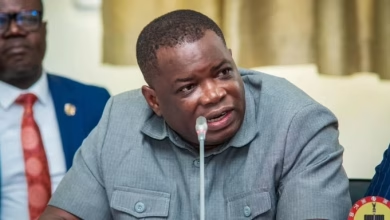
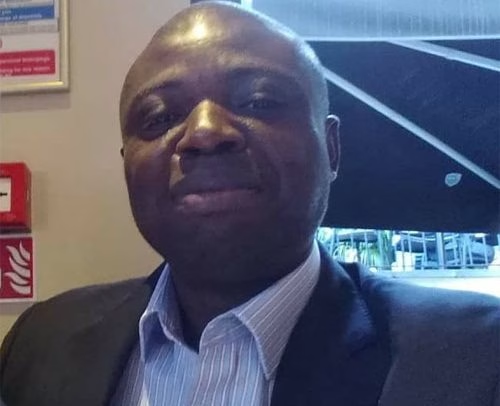
Security analyst Paul Boateng has warned that military intervention alone cannot resolve the long-standing conflict in Bawku and its surrounding areas, highlighting the urgent need for strong political will.
His comments come in the wake of renewed violence in Bawku and Nalerigu, which has prompted a curfew and the deployment of additional military forces.
Originally sent as peacekeepers, security personnel have now been directed by President John Dramani Mahama to enforce peace as tensions continue to rise.
“This isn’t the first time troops have been deployed to Bawku,” Mr. Boateng stated in a media interview. “The real question is, how long will we keep sending soldiers without addressing the root causes of the conflict?”
He noted that the Bawku conflict, which dates back to the 1930s, has been heavily politicized—an issue that continues to drive instability in the area.
“Even President Mahama has previously acknowledged the political nature of this conflict. That’s part of the problem,” Boateng said. “What we need is a locally-driven solution. Military efforts can only temporarily reduce tensions—they’re not a permanent fix.”
Boateng urged the government to adopt a new approach and demonstrate the political courage needed to resolve the issue for good.
“The government must act decisively and with political will,” he emphasized. “We can’t keep using the same tactics and expect different results.”
He also pointed to a broader issue affecting many African nations: the dominance of ethnic loyalty over national unity.
“One of Africa’s greatest obstacles is ethnicity. People often prioritize their tribal identities over their national ones,” he remarked.
Boateng called for the Bawku conflict to be treated as a national priority and urged President Mahama to honor his commitment to ending the crisis.
“The public is watching the President closely because he promised to bring peace to Bawku. He cannot afford to disappoint,” Boateng said. “Those responsible for the violence must face serious consequences to show that impunity will no longer be tolerated.”
He concluded by stressing that lasting peace in Bawku will depend not only on military presence, but also on sustained political commitment, meaningful community engagement, and firm accountability.