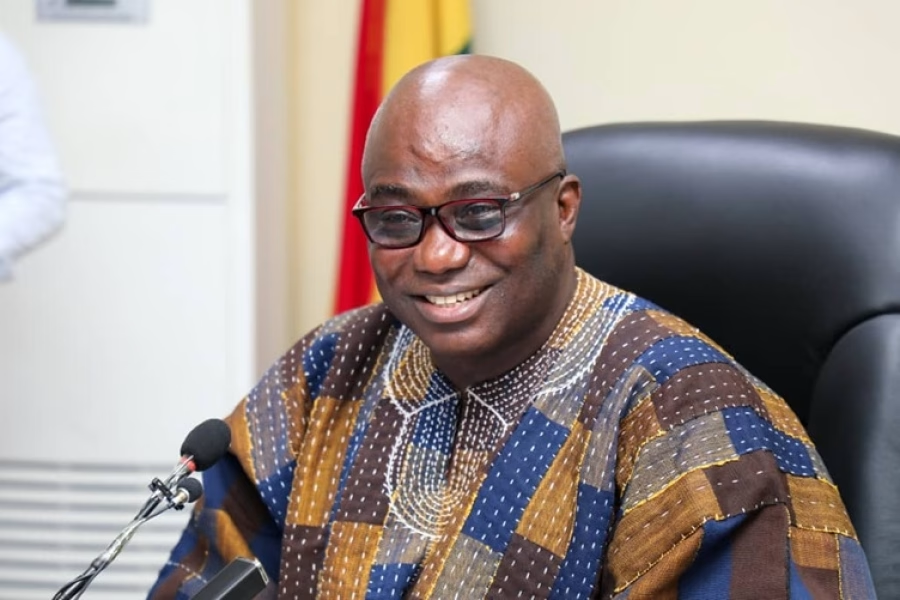
The government plans to release 10 million birds onto the local market before the end of 2025 as part of efforts to stabilise the poultry sector and reduce reliance on imports, according to the Minister of Food and Agriculture, Eric Opoku.
In an interview on Monday, November 10, 2025, Mr. Opoku noted that the ministry is managing a significant surplus of eggs this year, a situation expected to continue into 2026.
He highlighted that the government has implemented several measures to sustain poultry production. An initial GH¢100 million allocated to the National Food Buffer Stock Company (NAFCO) for purchasing staple grains has already been used, with an additional GH¢100 million recently released. Field assessments suggest about GH¢500 million may be required to absorb the excess harvest and stabilise market supply.
“This is the first time in our history that the Government of Ghana has intervened directly to procure essential food buffers for the nation,” Mr. Opoku said.
Under the Feed Ghana campaign, the “Nkoko Nkitinkiti” sub-programme is being executed in three phases:
- Support for household and backyard poultry keepers
- Assistance to medium-scale farmers with 1,000–3,000 birds
- Aid to around 50 established commercial producers
Mr. Opoku explained that the programme’s popularity has resulted in a temporary oversupply, which the release of 10 million birds into the market is expected to help manage, sustaining production and stabilising supply chains.
The minister also announced the establishment of a poultry processing centre in Dormaa through a public-private partnership. The facility will purchase birds from farmers, process them, and distribute products to the market, increasing domestic processing capacity.
Additionally, the ministry is linking soybean and maize producers with local feed processors to strengthen the raw material supply chain and boost domestic feed production. Local hatcheries are also being developed with private partners to reduce dependence on imported day-old chicks.
Mr. Opoku clarified that, following a presidential directive, the Ministry of Education, not NAFCO, will handle procurement of surplus eggs for the school-feeding programme.
The minister’s comments come ahead of the expected launch of the Nkoko Nkitinkiti initiative by President John Dramani Mahama in Kumasi later this week, marking the nationwide rollout of the poultry acceleration programme from backyard to commercial production.
“If we don’t act and allow this food to go to waste, it would discourage investment in agriculture. These interventions are designed to protect farmers and sustain agricultural growth,” Mr. Opoku said.