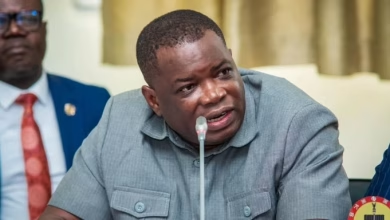
The Supreme Court challenge to the Ghana-US deportee agreement, brought by civil society group Democracy Hub, could hinge on Ghana’s international legal obligations, according to a leading legal scholar.
Professor Kwadwo Appiagyei Atua, an expert in international law at the University of Ghana, has emphasized that Ghana’s membership in global organizations and its commitments to international treaties—especially those prohibiting forced returns—must guide both Parliament and the Executive in considering the legality of the controversial agreement.
He underscored that while domestic legal procedures, such as parliamentary ratification of the Memorandum of Understanding (MOU), are important, they cannot override Ghana’s binding international commitments as a member of the United Nations (UN), African Union (AU), and ECOWAS.
Central to this issue, Professor Atua explained, is the principle of non-refoulement, a foundational tenet of international refugee and human rights law. This principle, enshrined in treaties like the UN Refugee Convention and the Convention Against Torture (CAT)—to which Ghana is a party—prohibits the return of individuals to countries where they risk torture or persecution.
“Parliament is bound by certain international agreements, such as the Convention Against Torture and the Refugee Convention, which include the principle of non-refoulement. This means you cannot deport someone to a country where they may already have suffered torture,” Professor Atua stated.
He explained that government actions must avoid returning individuals under circumstances where:
- The person has already been subjected to torture.
- Returning them would result in further torture.
- There are reasonable grounds to believe torture is ongoing in the destination country.
Professor Atua stressed that both the Executive and Parliament must consider all these legal obligations as Ghana plays its role in the international community.
International Law Should Shape Domestic Decisions
He further argued that, in cases involving fundamental human rights, international law may take precedence over domestic legislation.
“There are certain international laws that may override national laws, or at the very least, require us to align our local laws with our international obligations,” he explained.
According to him, this should be the basis on which Parliament determines whether to ratify and domesticate the MOU, making it a part of Ghanaian law.
These comments come ahead of the Supreme Court’s hearing scheduled for October 22, in a case challenging the government’s agreement with the US, which has involved the rerouting of at least 42 West African nationals—none of them Ghanaian—through Ghana after deportation from the United States.
Democracy Hub argues that Ghana’s role in detaining and re-deporting individuals—some of whom have court orders in the US protecting them from return due to risks of persecution—violates the non-refoulement principle.