The Third World Network-Africa (TWN-Africa) is voicing renewed concerns about Ghana’s mineral policy, arguing that the country’s approach—particularly in ongoing discussions about lithium—remains too narrowly focused on royalty rates rather than long-term value creation.
Parliament’s Majority Caucus has insisted that the Akufo-Addo administration’s agreement with Barari DV Ghana Limited, which set a 10% royalty for lithium mining, breached the Minerals and Mining (Amendment) Act, 2010, which caps royalties at 5%. The government has since submitted a revised agreement that complies with the legally required 5% rate.
TWN-Africa maintains that Ghana stands to benefit far more from its critical minerals by adopting a strategic, regionally coordinated approach and learning from successful models elsewhere.
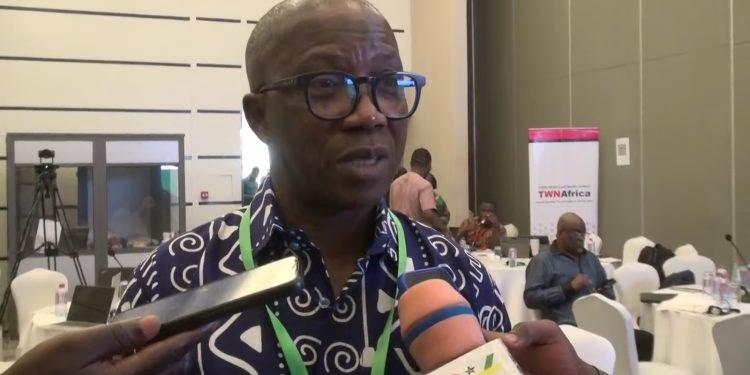
Speaking at the opening of an international consultation on Energy Transition, Critical Minerals, and Structural Economic Transformation in Africa, TWN-Africa Coordinator Dr. Yao Graham stressed that focusing solely on royalties limits Ghana’s potential.
He argued that real value lies in building industries around lithium—such as battery manufacturing—which drive renewable energy technologies and job creation. “Royalties are really at the bottom end of what you get from raw minerals,” he said, adding that Ghana must develop a clear industrial strategy, potentially in collaboration with other lithium-producing countries like Nigeria.
“The debate about royalties is important, but by itself it is very narrow,” Dr. Graham emphasised.
Claude Kabemba, Executive Director of the Southern Africa Resource Watch, echoed similar concerns, saying Africa must begin asserting itself in determining the prices of its natural resources.
He noted that while the continent is rich in minerals, it lacks the infrastructure to convert them into high-value products. In the short term, he argued, African countries must strengthen their capacity to negotiate contracts and maximise revenue. “We are in a position of power with our resources. How do we negotiate when the market is good? How do we become the ones who set the price of these minerals so we can raise enough revenue—and then invest in other sectors?” he said.