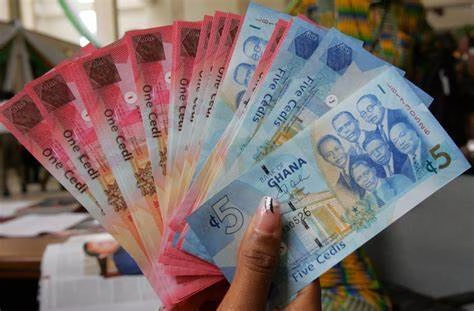
For a currency often marked by volatility, the Ghana cedi is making a subtle but noteworthy recovery. Defying expectations, it has held firm — and even shown signs of strength — against the US dollar in recent months, offering a rare moment of stability in a turbulent economic landscape. Yet beneath the surface, a key question remains: is this a genuine turning point or a temporary reprieve driven by calculated interventions?
Since December 2024, the cedi has experienced one of its most stable periods in recent years. In fact, it has occasionally appreciated against the dollar — an unlikely scenario just a few months ago. As of May 5, 2025, commercial banks were quoting the dollar at GH¢13.98, while forex bureaus priced it slightly higher at around GH¢14.40.
Between January and April 2025, the cedi gained 2.76% against the dollar, according to the Bank of Ghana. Analysts attribute this resilience to targeted monetary policies — including liquidity management and the central bank’s Gold Purchase Programme — which have helped boost market confidence and reduce speculative pressure.
The International Monetary Fund (IMF) has also recognized Ghana’s stronger-than-expected reserve accumulation. By the end of February 2025, gross international reserves stood at $9.3 billion, exceeding benchmarks set under the IMF’s Extended Credit Facility.
Further reinforcing optimism, the IMF’s latest Staff Level Agreement with Ghana has helped strengthen investor sentiment, suggesting that the country may be turning an economic corner.
Global institutions are also taking note. The World Bank, in its April 2025 Africa’s Pulse report, highlighted that the cedi had depreciated by only 4% in the first four months of the year — a marked improvement over previous years. Forbes even ranked the cedi as Africa’s seventh strongest currency by the end of Q1 2025.
While these indicators are promising, challenges persist. Inflation is easing — March 2025 saw a year-on-year rate of 22.4%, significantly lower than 2023 levels — but many Ghanaians continue to feel economic pressure. High market prices, elevated transport costs, and thin margins for small businesses remain widespread concerns.
Looking forward, the government is betting on the upcoming GoldBod initiative — a national gold-backed reserve program — to further stabilize the cedi by reducing foreign exchange dependency and reinforcing Ghana’s reserve position.
Dr. Johnson Asiama, the new Governor of the Bank of Ghana, is cautiously optimistic. In his first major address, he asserted that while the cedi must remain a floating currency, the era of extreme volatility is behind us.
It’s a bold claim, suggesting confidence in the current policy framework. However, the real test lies ahead: ensuring that macroeconomic stability leads to tangible improvements in the lives of ordinary Ghanaians.
For now, the cedi is enjoying a rare moment of calm. Whether that calm evolves into sustained recovery depends on policy consistency, fiscal discipline, and how effectively the benefits reach the broader population.
After all, true stability isn’t just about numbers — it’s about predictability at the market, affordability at the pump, and confidence in the future.