
- WAEC reports over half of candidates (220,008 out of 461,736) failed Core Mathematics in 2025 WASSCE
- Only 48.73% of candidates achieved grades A1-C6, down from 66.86% in 2024
- John Kapi identified seven areas of weakness, including diagrams, cumulative frequency tables, and word problem translation
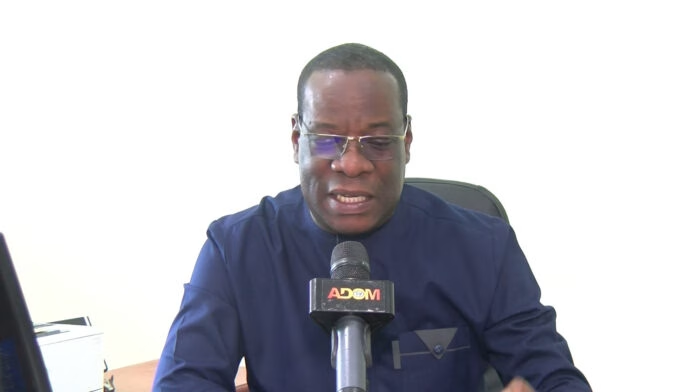
John Kapi, Head of Public Relations at the West African Examinations Council (WAEC), has attributed the significant drop in Core Mathematics performance in the 2025 West African Senior School Certificate Examination (WASSCE) to specific skill gaps among students.
Speaking on the JOY Super Morning Show, Mr. Kapi identified seven areas where candidates struggled: representing mathematical information in diagrams, solving global math-related problems, constructing cumulative frequency tables, making deductions from real-life scenarios, applying simple interest formulas, translating word problems into mathematical expressions, and interpreting cumulative frequency data.
“These are areas where chief examiners have observed weaknesses in candidates’ performance. Importantly, these are all topics within the syllabus and test blueprint,” he explained.
WAEC’s provisional results for the 2025 WASSCE reveal that over half of the candidates—220,008 out of 461,736—failed Core Mathematics, marking the lowest performance in seven years.
Data from WAEC shows a sharp drop in the percentage of candidates achieving grades A1 to C6, falling nearly 18 percentage points from the previous year. Only 48.73% of candidates attained A1-C6 grades in 2025, compared to 66.86% in 2024. While 209,068 candidates passed with A1-C6, 114,872 (26.77%) failed outright with an F9 grade.
A total of 1,021 schools registered candidates for the exam, a slight 0.24% increase over 2024, while 5,821 candidates (1.26%) were absent.
John Kapi emphasized that the decline does not indicate a deviation from the curriculum but highlights the urgent need to strengthen teaching methods and enhance students’ practical problem-solving skills.