- Kwesi Pratt Jnr calls Africa’s dependence on colonial systems “tragic”
- New book demands over $12 trillion in reparations
- Launch features cultural performances and high-value book auction
Veteran journalist and Pan-Africanist, Kwesi Pratt Jnr, has described Africa’s continued dependence on colonial-era systems for economic and political direction as “nothing short of tragic.”
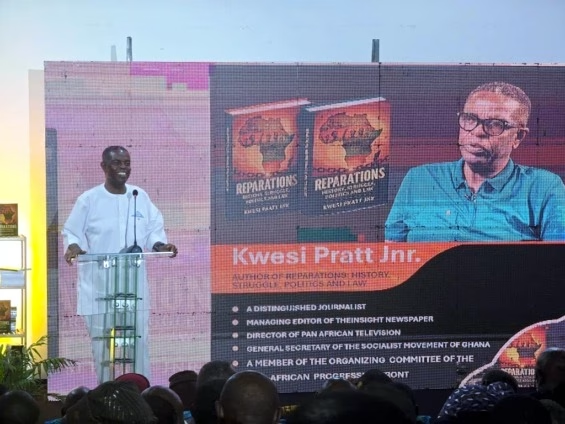
Speaking at the launch of his latest book, Reparations: History, Struggle, Politics and Law, held in Accra on September 9, 2025, Pratt argued that Africa must stop accepting solutions from the very powers responsible for its historical exploitation.
“We must stop taking prescriptions from those who poisoned us,” he said. “The same nations that enslaved, colonised, and looted Africa cannot be trusted to solve the problems they created.”
According to Pratt, Africa’s enduring poverty and systemic vulnerabilities are direct outcomes of slavery and colonialism. He cautioned that emulating the economic models of former colonial powers like Britain, France, and Germany would only exacerbate the continent’s challenges.
“We’re borrowing our own wealth from foreign banks and the IMF at exorbitant interest rates. This must end,” he stated firmly.
Reparations Framework
Supported by the Pan-African Progressive Front (PPF), the book proposes a structured and practical approach to reparations, estimating Africa’s entitlement at:
- $2–3 trillion for unpaid slave labour
- $4–6 trillion for colonial resource extraction
- $500 billion for debt cancellation
- $50 billion for repatriation of stolen artefacts
- $1 trillion for climate reparations
High-Profile Launch
The event attracted a distinguished audience including former President John Dramani Mahama, diplomats, traditional rulers, and political figures. In the book’s foreword, Mahama emphasized that reparations are not an act of charity but a matter of justice.
“Reparations are justice. And justice must be seen and felt,” he said, commending Pratt for giving clarity and direction to Africa’s ongoing struggle for restitution.
Pratt stressed that the book goes beyond history—it is a blueprint for mobilising collective action across the continent.
“This is a call to action. Reparations should not only reorganise global justice but also help lay the foundation for a self-reliant Africa,” he said. He also pointed out that many global financial institutions and multilateral bodies still operate with frameworks established without African voices, reinforcing colonial-era disparities.
Cultural Showcase and Book Auction
The launch was enriched with cultural performances by the Freedom Band, musician Knii Lante Blankson, and a powerful poetry recital by Vicky Wilson. President Mahama purchased the first gold-plated copy for GH¢200,000, while nine others were auctioned for amounts ranging from GH¢100,000 to GH¢10,000.
Ambassador Kabral Blay-Amihere, who reviewed the book, praised its depth and urgency. Chairing the event, historian Kyeretwie Opoku underscored the need for a unified continental effort:
“Reparations cannot be pursued by one person, organisation, or government alone. It must be a collective African struggle, spoken with one voice.”
Already presented to African Union Heads of State at their July 2025 summit in Malabo, the book has gained significant traction, prompting additional print runs to meet growing demand. It is positioned as a key resource for activists, students, policymakers, and African youth committed to building a better future.