- Ghana’s first shared 4G/5G network ceremonially launched November 2024, but no live 5G network yet
- Minister warns of consequences if deadlines are missed but urges regulatory support
- Coordinated government and regulator action needed to realize Ghana’s 5G potential
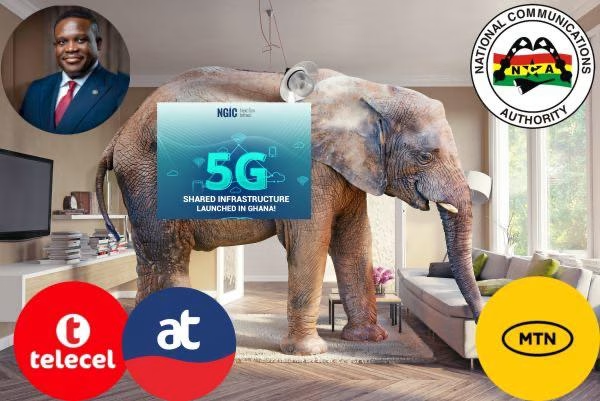
On November 1, 2024, a grand ceremony took place at La Palm Royal Beach Hotel to mark the official launch of Ghana’s first shared 4G/5G network. This network, operated under an exclusive 10-year license granted to Next Generation Infrastructure Company (NGIC), represented a major milestone. However, this was a ceremonial launch—not the start of live public service.
As of today, six months after the event, there is still no live public 5G network available in Ghana.
The former Minister of Communications and Digitalization, Ursula Owusu-Ekuful, who oversaw the launch, set a December 2024 deadline for the three major telcos—MTN, Telecel, and AT Ghana—to offer live 5G services to the public. She asserted that the network infrastructure was ready, and customers should question any telco that failed to provide 5G by that date.
Despite this promise, the deadline has been extended multiple times—from December 2024 to January 2025, then to May 2025. Recently, the new sector Minister, Sam George, announced that NGIC assured him the 5G network would go live in June 2025, but even this deadline has passed without a public rollout.
Minister George warned that if NGIC misses the June deadline, there could be consequences including a potential review of the 10-year exclusive license. While the Minister expressed reluctance to terminate contracts due to financial implications for the state, he affirmed that license terms would be reviewed if necessary.
Operational and Regulatory Challenges
Tower Deployment Delays
Minister George noted NGIC’s commitment to deploy 350 cell sites by June—200 to 250 in Accra and 100 to 150 in Kumasi, including at least 50 5G sites. However, only 22 sites have been deployed so far, mostly in Accra and Kumasi, far below expectations.
The equipment needed for the rollout is already warehoused in Ghana but awaits crucial regulatory approvals to justify full deployment. Rolling out infrastructure without agreements with tower companies (towercos) risks financial losses, as seen in past telecom ventures.
Tower Company Hesitation
NGIC still faces difficulty securing commitments from key towercos such as ATC and Helios Towers, which remain cautious due to historical unpaid debts by some telcos. For example, ATC claims AT Ghana owes GHS 1.5 billion in unpaid bills. This financial uncertainty makes towercos reluctant to fully support the rollout without stronger guarantees.
NGIC’s shared infrastructure model aims to centralize accountability and reduce debt accumulation, but regulatory support is vital to rebuild confidence among stakeholders.
Delays in Network Certification
The National Communications Authority (NCA) completed a technical inspection of NGIC’s Network Operation Centre weeks ago but took eight weeks to issue the official report—a necessary step before full operational clearance. This delay has also contributed to the rollout timeline slipping.
Pending Regulatory Approvals
- SIM Cards and PLMN Authorization: The NCA has only granted limited approval for testing, allowing 50 SIM cards and a Public Land Mobile Network (PLMN) for integration tests, but full commercial deployment permissions remain pending.
- Spectrum Interference: There have been ongoing issues with interference in the 3.5 GHz and 2.1 GHz bands, partly due to conflicts with Ghana Civil Aviation Authority equipment and unexplained background noise (“raised noise floor”) affecting signal quality. Some progress has been made with frequency adjustments, but testing continues.
- Connection Approvals for Telcos and ISPs: Key licenses and regulatory frameworks to allow telcos (AT and Telecel) and ISPs to connect to NGIC’s shared network are still not finalized, limiting NGIC’s ability to integrate retail service providers and commence commercial operations.
Looking Forward
Once all regulatory approvals are in place, NGIC will require an estimated 6–8 weeks to complete technical configuration and testing before launching wholesale services.
Minister George’s deadline serves as a critical accountability marker. However, it is essential that regulatory bodies fulfill their roles promptly to clear bottlenecks. Without timely support from the regulator, setting operator deadlines alone will not bring 5G to Ghana’s consumers.
Strategic Benefits of NGIC’s Shared Network Model
- For Government and Regulator: Reduces infrastructure duplication, promotes digital inclusion, and enforces transparent licensing.
- For Telcos and ISPs: Enables access to nationwide networks without high infrastructure costs and fosters fair competition.
- For Towercos and Investors: Centralizes accountability, lowers credit risks, and rebuilds trust within the telecom ecosystem.
- For Consumers: Accelerates access to affordable, reliable 4G/5G services, especially in underserved areas, enhancing choice and service quality.
Conclusion
To realize the full potential of Ghana’s shared 4G/5G infrastructure, coordinated regulatory action must match the significant investments made. Ghana stands at a pivotal moment to break monopolistic barriers, restore investor confidence, and lead digital transformation in West Africa.
Prolonged delays threaten not only NGIC’s success but the nation’s broader economic and technological advancement goals.
Samuel Dowuona is an award-winning journalist and telecom industry analyst. He can be reached at dowuonasamuel24@gmail.com.