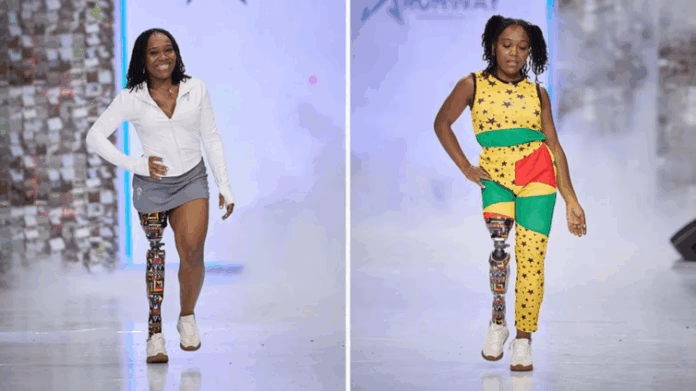
It was impossible to overlook 33-year-old model and writer Abena Christine Jon’el at a recent major fashion show in Ghana. Striding confidently down the runway in a vibrant African print, her prosthetic leg wrapped and on full display, she left a lasting impression.
For the Ghanaian-American, the moment was about far more than fashion. It was a deliberate statement on visibility and inclusion for people with disabilities—an issue she has championed for years both in the United States and in Ghana.
Abena’s journey began with a life-altering challenge at just two years old. A tumour discovered on her right calf was diagnosed as rhabdomyosarcoma, a rare and aggressive soft-tissue cancer. Doctors presented her mother with two difficult options: radiation treatment, which could have left her wheelchair-bound, or amputation. Her mother chose amputation—a decision Abena now reflects on without regret.
“It was the best decision she could have made,” she says, speaking to the BBC in Accra, surrounded by friends and family.
Although she now lives in Ghana, Abena was raised in Chicago. Long before she fully understood cancer, her childhood was shaped by medical treatment, recovery, and relearning movement. Physical motion became both a marker of survival and a means of reclaiming confidence—of taking ownership of a body that had endured so much.
However, Abena rejects the stereotypical narrative often used to portray disabled children as quiet, compliant, and inspirational figures.
“People imagine disabled kids as perfect, soft-spoken overachievers,” she says. “That was not me. I was loud, stubborn, running around on one leg, and struggling in school.”
Rather than dulling her personality, her disability sharpened it. That same intensity—what she now jokingly calls her “professionally inspirational” energy—would later propel her forward.
In the US, Abena built a career as a writer, starting with poetry, and later became a public speaker, sharing her lived experiences to inspire others. Her goal was not pity, but reflection—to show people what was possible and encourage them to see their own potential.
Even then, she felt an unexplainable pull toward Africa. As a young adult, she immersed herself in African history, particularly pre-colonial West Africa. The more she learned, the stronger the connection became.
Her first visit to Ghana in 2021 was transformative.
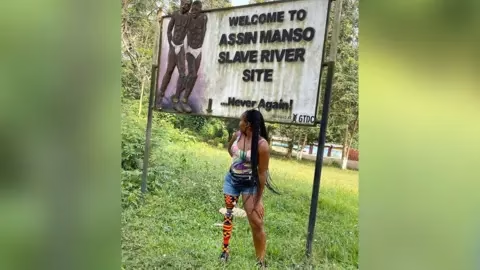
While standing at the Assin Manso slave river site—where enslaved Africans were once held before being sent to the coast—she experienced what she describes as a moment that fundamentally reshaped her sense of self. The weight of history merged with a profound sense of belonging she had never known growing up in the US.
Returning to America left her deeply unsettled.
“It felt like I had found a missing piece of myself,” she recalls. “Leaving Ghana felt like being torn away from where my soul belonged.”
Three months later, she relocated permanently.
Since then, Ghana has embraced her in ways she still finds difficult to articulate. Over the four years she has lived in Accra, she has been claimed by community, culture, and family. She now lives with a Ghanaian woman who proudly introduces her as her daughter.
“My Ghanaian identity is not pretend,” Abena says firmly. “It is ancestral. Like Kwame Nkrumah said, ‘I am not African because I was born in Africa, but because Africa was born in me.’ That is exactly what Ghana is to me.”
Her prosthetic leg itself reflects that bond. Wrapped in kente, it serves not only as a mobility aid but also as a cultural symbol.
“It has always been kente,” she says. “It represents my love for this country—its heritage and pride.”
Living with a disability in Ghana has given her advocacy renewed purpose. For Abena, the difference between disability experiences in Ghana and the US lies largely in visibility and access.
“In the US, progress is slow and imperfect, but disabled people are being invited into more spaces,” she explains. “Ghana is still at the beginning—not because of a lack of compassion, but because of limited representation.”
She believes stigma thrives when disabled people are only seen through struggle rather than strength, beauty, or joy.
Her mission is to change that narrative—not through pity, but through presence.
With her bold personality, kente-wrapped prosthetic, and refusal to shrink herself to meet expectations, Abena wants Ghanaians to see disabled people as they truly are: complex, talented, ambitious, stylish, and human.
“Disability is not the limitation,” she says. “What disables people is the lack of access, support, and opportunity.”
That message reached a powerful new audience at the 15th edition of Rhythms on the Runway, one of Africa’s most prominent fashion events, held last month at Accra’s historic Osu Castle.
In the lead-up to the show, Abena approached the organisers herself, fully aware of the statement her participation would make.
“If I wanted inclusivity, I had to be willing to take the first step,” she says.
When she stepped onto the runway, draped in confidence and colour, the atmosphere shifted. Her walk quickly became one of the most talked-about moments of the night.
Tourism, Culture and Arts Minister Abla Dzifa Gomashie described her presence as deeply powerful, while organisers and cultural figures praised the moment as a true representation of inclusion.
But for Abena, the applause was secondary. What mattered most was the message: disabled people were no longer on the sidelines—they were centre stage.
Standing at the intersection of identity, disability, heritage, and fashion, Abena represents a bold new vision for Ghana—one where inclusion is not quietly suggested but confidently claimed.
Her journey is not merely one of survival, but of reclamation: reclaiming her body, her identity, her belonging, and her place in a country she says “fought for me before I even arrived.”
Her work continues. Whether on a runway, behind a microphone, or mentoring young amputees, she remains unwavering in her resolve.
“Ghana is my home,” she says.