- Mauritania’s Sidi Ould Tah becomes AfDB’s 9th president
- Succeeds Akinwumi Adesina, who led AfDB through a decade of expansion
- Introduces new "peace investment" pillar in AfDB strategy
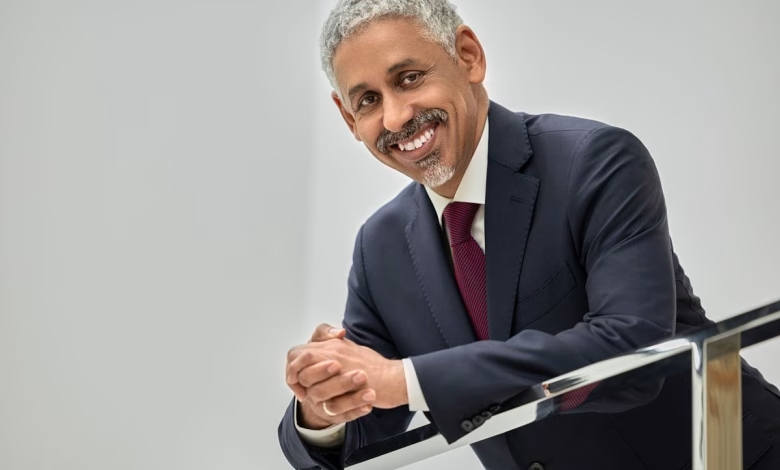
Mauritanian economist Sidi Ould Tah was officially sworn in on Monday as the ninth President of the African Development Bank (AfDB), following his election on May 29 with 76.18% of the vote during the institution’s annual meetings.
He takes over from Dr. Akinwumi Adesina, who concludes a decade-long tenure widely seen as transformative for the Bank and the continent.
Previously the Director General of the Arab Bank for Economic Development in Africa (BADEA), Mr. Tah said he assumes the presidency at a “critical moment” for Africa. Founded in 1964, the AfDB has grown into the continent’s largest development finance institution.
Outlining his vision for the first 100 days, Tah promised to:
- Prioritize listening and consultation
- Accelerate internal reforms
- Strengthen collaboration with governments, private sector, and international partners
- Expand engagement with new players such as sovereign wealth funds and pension funds
He also pledged to revisit AfDB’s investment models by introducing a new pillar focused on peace-building investments. Addressing staff, he described them as the Bank’s “greatest asset” and announced an upcoming town hall meeting to foster engagement.
Positioning AfDB as a strategic guide for Africa amid demographic change, climate shocks, and digital transformation, Tah emphasized the need for focus:
“The Bank must not try to be everything to everyone—it should target areas where it can truly make a difference.”
Adesina’s Legacy: A Decade of Growth and Impact
Outgoing President Dr. Akinwumi Adesina, a former Nigerian Minister of Agriculture, ends his tenure after two successful terms marked by expansion and growing global recognition for AfDB.
Key achievements during Adesina’s presidency include:
- Capital base growth from $93 billion (2015) to $318 billion (2025)
- A record $8.9 billion replenishment for the Bank’s concessional window
- Launch of the Africa Investment Forum, mobilizing $180 billion in commitments
- Issuance of a $3 billion COVID-19 social bond—one of the largest of its kind globally
According to AfDB, over the past decade the Bank’s programs have improved the lives of 515 million Africans, including 231 million women, by enhancing access to healthcare, clean water, ICT, electricity, and sanitation.
Global leaders such as WTO Director-General Ngozi Okonjo-Iweala and UN Secretary-General António Guterres praised Adesina’s leadership, citing his contributions to food security, climate financing, and pandemic resilience.
Now leading a financially stronger institution with a louder global voice, Sidi Ould Tah faces significant challenges ahead: rising debt levels, climate risks, tightened financing conditions, and shifting investor confidence.