Ghana appears to be entering a phase of economic recovery. Inflation has been steadily falling through the first half of 2025, and macroeconomic indicators are pointing toward stability. The IMF and Deloitte both project inflation could drop to single digits by year-end, possibly as low as 8%. In June 2025, annual inflation fell sharply to 13.7%, down from 18.4% in May, while month-on-month inflation dropped by 1.2%.
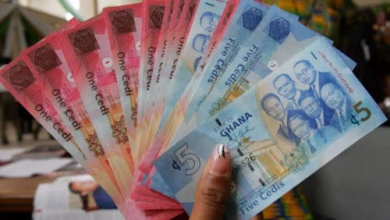
The Ghanaian cedi has also seen a historic rebound—gaining 42% against the U.S. dollar, 30.3% against the British pound, and 25.6% against the euro. From GH¢17 in November 2024, the cedi has appreciated to GH¢10.30 as of June 2025.
But Ghanaians are asking: if the numbers look so good, why isn’t life getting easier?
Disconnect Between Macroeconomic Gains and Market Reality
Despite the positive economic data, the cost of essential goods—particularly food, cement, and building materials—remains high. A PwC survey found that 45% of respondents see no real-life impact from the reported drop in inflation.
One key issue is that while inflation (the rate of price increase) is slowing, prices themselves are still rising. This is especially true for food, where high production costs, seasonal supply challenges, and inefficient supply chains continue to affect prices.
Power Dynamics in Food Markets
Ghana’s food distribution system remains largely under the control of market queens and middlemen, who exert significant influence over pricing, supply, and market access. Their dominance makes it difficult for price drops to trickle down to the average consumer.
Post-harvest losses—estimated at $2 billion annually by the World Food Program—further exacerbate the problem. Much of this is due to poor storage infrastructure and limited processing capacity.
Other Price Pressures
- Delivery Costs: Unregulated and often higher than the product itself.
- Galamsey (illegal mining): Continues to destroy farmland and pollute water sources, reducing food production and raising prices.
- Cement Prices: Still at GH¢120 per bag—far above what the current exchange rate and inflation levels suggest it should be.
Political connections among powerful market actors and weak enforcement make reform challenging.
What the Government Must Do
This is not just an economic concern—it’s a governance issue. For Ghana’s macroeconomic progress to be meaningful, policies must translate into affordability and access. Here’s how:
🔹 1. Expand Social Support
Scale up programs like LEAP and introduce food vouchers, linking them to local food distribution networks to bypass exploitative intermediaries.
🔹 2. Increase Domestic Food Supply
Invest in irrigation, mechanisation, and support services to boost year-round agricultural production.
🔹 3. Cut Post-Harvest Losses
Develop cold storage systems and rural feeder roads to extend the shelf life and reach of local produce.
🔹 4. Promote Agro-Industrialization
Encourage value addition through agro-processing. Offer incentives to small agribusinesses and farmer cooperatives.
🔹 5. Disrupt Market Monopolies
Empower NAFCO to buy directly from farmers and distribute efficiently, reducing reliance on market queens.
🔹 6. Enhance Market Oversight
Create a price monitoring and forecasting unit to provide real-time market data for better planning and response.
🔹 7. Import Substitution
Invest strategically in crops like rice, tomatoes, and poultry to reduce import dependence and protect local production.
🔹 8. Enforce Mining Laws
Crack down on illegal mining and invest in land restoration to revive agriculture in affected areas.
Conclusion: Turning Stability into Real Progress
Ghana is on the brink of a potential economic turnaround. But falling inflation and a strong cedi mean little if the cost of living remains high and basic goods stay out of reach. This is a moment for bold political will—not just economic management.
To make the recovery real, the government must fix inefficiencies, challenge monopolies, and prioritize inclusive policies that reflect the lived realities of everyday Ghanaians. Only then can Ghana build a resilient, self-reliant economy that delivers for all.