- Dr. Daniel Acquaye welcomes the rise of the agriculture budget from 0.5% in 2025 to 5% in 2026—about GH¢13 billion
- Warns that Ghana’s US$1.9 billion annual post-harvest losses could undermine progress if not addressed
- Highlights recurring food shortages and gluts caused by systemic failures and weak infrastructure
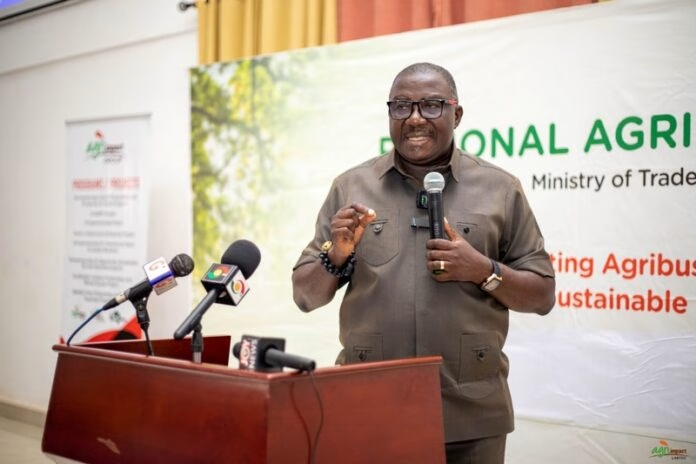
The Chief Executive Officer of Agri-Impact Limited, Dr. (h.c.) Daniel Fahene Acquaye, has praised the government for increasing the agriculture and agribusiness budget from 0.5% in 2025 to 5% in 2026, describing it as a bold move to strengthen the sector.
Speaking at the Regional Agribusiness Dialogue on Tuesday, December 9, 2025, at the Global Dream Hotel in Tamale, he noted that the new allocation—about GH¢13 billion—is ten times higher than last year’s.
Despite welcoming the increase, Dr. Acquaye warned that without addressing Ghana’s annual post-harvest losses, estimated at US$1.9 billion, the investment may not lead to meaningful transformation. He emphasised that the new budget represents only half of the country’s post-harvest losses, underscoring the urgent need to tackle the problem.
Addressing recurring food shortages and gluts, he criticised the long-standing pattern where droughts lead to scarcity and good rainfall results in excess produce, describing it as a systemic issue that must be fixed. He pointed out the disconnect between production and processing, where farmers struggle to find processors and processors lack consistent raw materials.
Dr. Acquaye stressed that Ghana must prioritise infrastructure such as roads, irrigation, storage, and market access to prevent continued losses and ensure farmers benefit from their labour.
Turning to Northern Ghana, he highlighted the region’s vast potential—covering over 40% of Ghana’s land area and producing major crops such as rice, maize, soya, yam, and groundnut. Yet, due to inadequate investment and limited agro-processing facilities, its potential remains untapped. He noted that yam losses alone amount to 30% of the entire 2026 agriculture budget.
He urged both government and the private sector to invest heavily in processing plants and post-harvest systems to transform the region into the country’s main food source.
At the same event, Deputy Minister for Trade, Agribusiness and Industry, Sampson Ahi, reaffirmed government’s commitment to making agribusiness central to Ghana’s industrialisation and 24-hour economy agenda.
Represented by Mr. George Owusu Ansah Amoah, he referenced projections showing the global agribusiness market growing from US$3.4–US$3.5 trillion today to as much as US$5.8 trillion by 2033. He highlighted opportunities for Ghana in innovation, value addition, and sustainable practices.
The Deputy Minister also announced a two-phase plan to enhance access to agricultural machinery, beginning with tax waivers on agro-processing equipment to encourage investment.
The Agribusiness Dialogue forms part of the Ministry’s nationwide consultations—supported by Agri-Impact Limited—to shape Ghana’s first national agribusiness policy.