- Vice President Naana Jane Opoku-Agyemang reaffirms Ghana’s dedication to sustainable agriculture
- Delivered closing keynote at the Norman E. Borlaug International Dialogue on global food systems
- Announces creation of a Women’s Development Bank to support female farmers and entrepreneurs
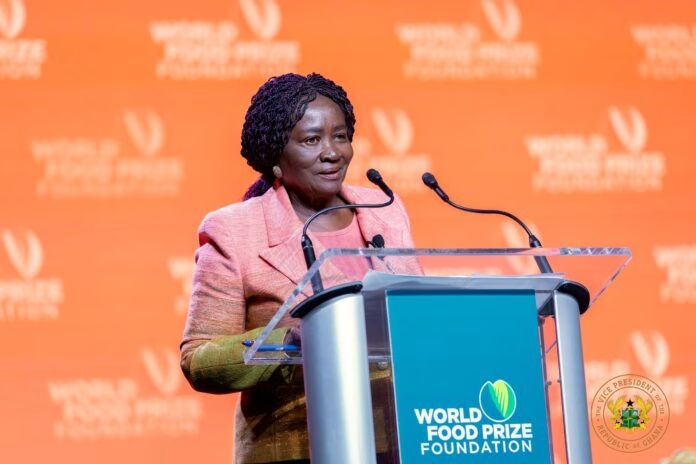
Vice President Prof. Naana Jane Opoku-Agyemang has reiterated Ghana’s strong commitment to agricultural transformation, food security, and inclusive economic growth during her keynote address at the Norman E. Borlaug International Dialogue, a leading global conference on food and agriculture.
Delivering the closing keynote address, Prof. Opoku-Agyemang reflected on the enduring legacy of Dr. Norman Borlaug, whose belief that “no child should go to bed hungry” continues to guide international efforts in agriculture and hunger eradication. She emphasized that this moral vision must continue to shape today’s strategies for food security and agricultural development.
Highlighting agriculture’s central role in Ghana’s economy, the Vice President noted that nearly two in every five Ghanaians depend on farming for their livelihoods. Despite this, Ghana still spends over USD 2 billion annually on food imports—a situation she said must change given the country’s vast potential to produce what it consumes.
Prof. Opoku-Agyemang outlined President John Dramani Mahama’s vision for transforming agriculture through the Feed Ghana Programme, which targets 22 key commodity value chains—covering grains, legumes, vegetables, tree crops, and livestock. The programme aims to address major challenges in irrigation, storage, processing, digital integration, cooperative development, and market access.
She also highlighted the Grow24 Programme, a flagship initiative under Ghana’s 24-Hour Economy agenda, designed to modernize agriculture, boost agro-manufacturing, and support export-ready agribusinesses. Complementing these efforts is a five-year Agricultural Risk Management Strategy, focused on stabilizing poultry, tomato, and maize production in select regions.
Addressing gender equity, Prof. Opoku-Agyemang underscored that women—who make up more than half of Ghana’s agricultural workforce—continue to face barriers to land, finance, technology, and training. To tackle this, the government is establishing a Women’s Development Bank to enhance women’s access to credit and economic empowerment.
She further emphasized Ghana’s investment in youth-led agritech, mechanization, and digital market platforms to drive innovation and attract young people into agriculture.
Prof. Opoku-Agyemang also highlighted Ghana’s ongoing shift from exporting raw commodities to producing value-added agricultural products. With the African Continental Free Trade Area (AfCFTA) headquartered in Accra, she said Ghana is well-positioned to develop regional value chains, expand agro-exports, and empower women and youth across the continent.
The Vice President extended an open invitation to investors, development partners, and research institutions to collaborate with Ghana in advancing sustainable agricultural transformation.
Following her address, Prof. Opoku-Agyemang joined Dr. Akinwumi A. Adesina, outgoing President of the African Development Bank, in a fireside chat on Ghana’s agricultural modernization and value addition strategies.
The event concluded with the presentation of the 2025 World Food Prize to Dr. Marieangela Hungria, a Brazilian agronomist and microbiologist celebrated for her groundbreaking research on biological nitrogen fixation—a major breakthrough for sustainable global agriculture.
Prof. Opoku-Agyemang’s participation reaffirmed Ghana’s leadership in food systems innovation, with her message of partnership, inclusion, and transformation resonating deeply with the legacy of Dr. Borlaug.