
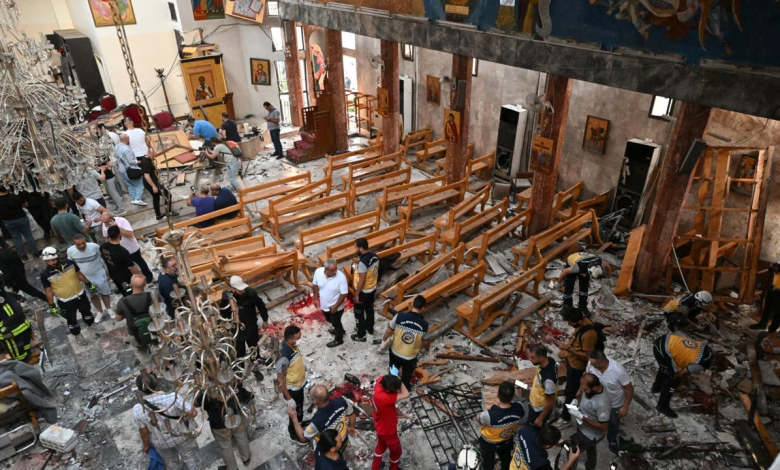
- 22 killed, 63 injured in suicide bombing at Greek Orthodox Church
- Attacker opened fire before detonating explosive vest
- Greek Orthodox Patriarchate calls victims “martyrs”
At least 22 people were killed and 63 others injured in a suicide bombing at a church in Damascus, Syria, according to the country’s health ministry.
The attack occurred Sunday evening during a service at the Greek Orthodox Church of the Prophet Elias, located in the Dweila neighborhood. A man reportedly opened fire inside the church before detonating an explosive vest, Syria’s interior ministry stated.
Authorities say the attacker was linked to the Islamic State (IS), though the group has not officially claimed responsibility.
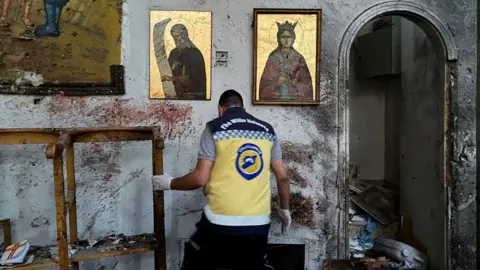
Images from the scene show severe destruction—shattered pews, a damaged altar, and bloodstains on the walls.
Eyewitness Lawrence Maamari told AFP that the assailant entered the church carrying a weapon and began shooting. “People tried to stop him before he blew himself up,” he said. Another witness, Ziad, described hearing gunfire followed by a blast that sent glass flying and ignited a fire inside the church.
This marks the first major attack in Damascus since Islamist-led rebels overthrew President Bashar al-Assad in December, bringing an end to 13 years of civil war.
In a statement, the Greek Orthodox Patriarchate of Antioch mourned the victims, describing them as martyrs. “The treacherous hand of evil struck this evening… during the evening divine liturgy,” it said. The blast reportedly occurred near the entrance, killing both worshippers and bystanders.
The Patriarchate also called on Syria’s interim authorities to take full responsibility for protecting places of worship and ensuring the safety of all citizens.
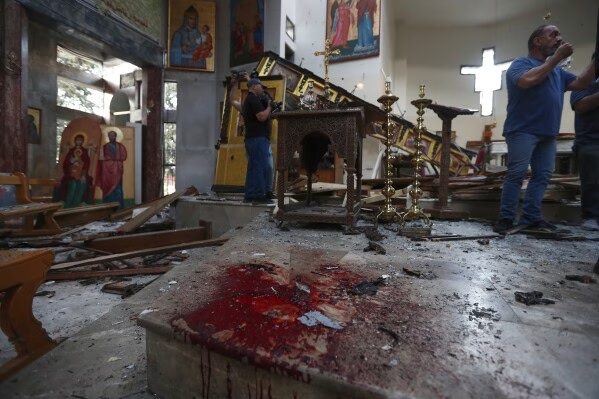
Interior Minister Anas Khattab said an investigation had been launched, calling the incident a “heinous crime.” He added, “These terrorist acts will not derail the Syrian state’s pursuit of civil peace.”
International reactions quickly followed. UN Special Envoy Geir Pedersen condemned the bombing, urging Syrians to reject terrorism and sectarianism. US Special Envoy Tom Barrack described the attack as “a cowardly act” and said it had no place in Syria’s future, which he described as “a tapestry of tolerance and inclusion.”
Interim President Ahmed al-Sharaa, whose Sunni Islamist group Hayat Tahrir al-Sham (HTS) is a former al-Qaeda affiliate, has repeatedly promised to protect religious and ethnic minorities. However, Syria has recently experienced two waves of deadly sectarian violence.
IS has a history of targeting religious minorities in Syria. In 2016, the group claimed responsibility for a series of explosions near the Sayyida Zeinab Shia shrine in Damascus, which killed over 70 people.
At its height, IS controlled an area of 88,000 square kilometers across Syria and Iraq and ruled over nearly eight million people with extreme brutality. Although the group was militarily defeated in Syria in 2019, the UN continues to warn that IS remains a serious threat.
A February report revealed IS still maintains between 1,500 and 3,000 fighters across Syria and Iraq, with many key leaders operating from within Syria. Around 300 militants are reportedly based in the central Badia desert, which serves as a base for planning attacks abroad.
Currently, more than 9,000 IS fighters are held in detention facilities in northeastern Syria, along with 40,000 women and children affiliated with the group living in camps.