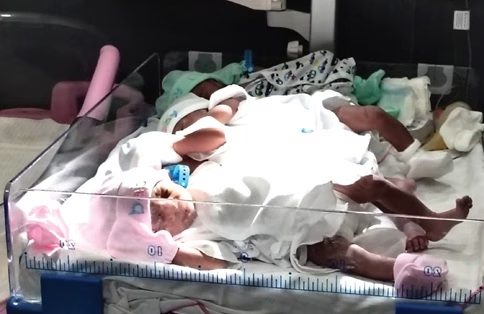
The Walking Egg Medical and Fertility Centre in Pokuase, Greater Accra Region, has successfully delivered quadruplets through intrauterine insemination (IUI), a highly uncommon outcome in assisted reproductive medicine. The babies were carried by a 30-year-old surrogate mother.
The Chief Executive Officer of the centre, Dr Nana Yaw Osei, who supervised and conducted the delivery, explained that quadruplet births resulting from IUI are extremely rare because the procedure does not allow doctors to control the number of embryos that implant, unlike in vitro fertilisation (IVF).
“It is very unusual to have four babies from IUI. Normally, we expect one, or at most two,” Dr Osei said.
Speaking to the Daily Graphic shortly after the delivery, Dr Osei described the pregnancy as uneventful, noting that the surrogate experienced no significant complications.
“As a precaution, we delivered at 36 weeks. All four babies were examined by paediatricians and were found to be in excellent health,” he said.
Dr Osei disclosed that the decision not to pursue foetal reduction was based on ethical and religious convictions.
“As a committed Christian, I consider foetal reduction to be equivalent to abortion. After extensive discussions with the intended parents and the surrogate, we unanimously agreed to carry all four foetuses to term. It was truly a special experience,” he explained.
Although carrying quadruplets is medically classified as high-risk, the surrogate had a smooth pregnancy. The babies — two boys and two girls — were all delivered safely, each weighing more than two kilogrammes.
Dr Osei further clarified that IUI relies largely on natural processes.
“With IUI, we prepare the sperm and introduce it into the uterus, but we cannot determine how many embryos will implant. Unlike IVF, where fertilisation occurs outside the body and the number of embryos transferred can be controlled, IUI depends entirely on nature. That is what makes this case so exceptional,” he noted.
Beyond the medical achievement, Dr Osei also touched on the cultural and social dimensions of assisted reproduction in Ghana.
“Surrogacy is still evolving in our society. Many surrogates are independent women, often motivated by financial considerations. We also require that surrogates have at least one child of their own to minimise medical and emotional risks,” he said.
Reflecting on the broader impact of assisted reproductive technology, Dr Osei recalled the story of a 49-year-old woman who lost her womb but remained steadfast in her desire to have a child.
“Should such women be denied the chance to experience motherhood? Assisted reproduction offers hope to families who might otherwise never have children,” he said.
He added that both donors and surrogates remain anonymous to protect the privacy of all parties involved.
“Our aim is to blend advanced medical practice with ethical and culturally sensitive values. This successful quadruplet delivery highlights the growing potential of assisted reproductive technology in Ghana and offers renewed hope to couples facing infertility challenges,” Dr Osei emphasised.