Ghana’s rapidly expanding digital finance ecosystem is facing a major trust challenge, as industry experts caution that low public confidence could slow adoption and undermine the nation’s financial inclusion goals.
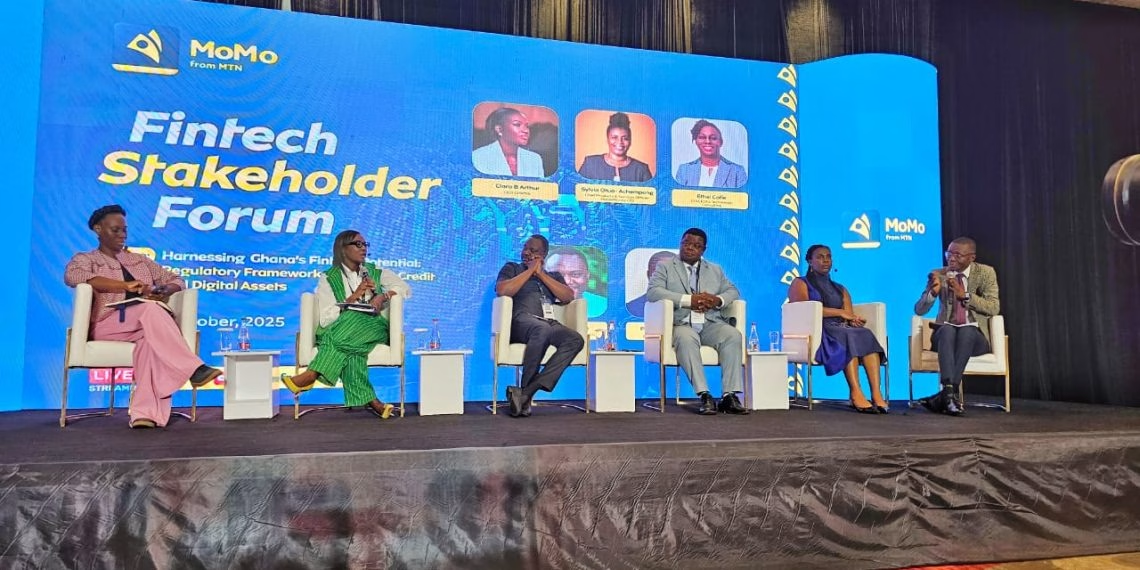
At the 2025 Fintech Stakeholder Forum in Accra, stakeholders from the fintech, banking, and regulatory sectors expressed concern that despite strong growth in mobile money and digital credit platforms, many Ghanaians remain hesitant to fully embrace the system due to fears of fraud, data breaches, and weak consumer protection.
Held under the theme “Harnessing Ghana’s Fintech Potential: Regulatory Frameworks for Digital Credit and Digital Assets,” the forum gathered regulators, fintech firms, banks, academics, and policy experts to explore ways to strengthen digital payments and promote responsible innovation.
Financial Literacy and Trust Gaps
Professor Peter Quartey, former Director of the Institute of Statistical, Social and Economic Research (ISSER) at the University of Ghana, noted that while overall financial literacy in Ghana is “medium,” trust and usage levels in digital finance remain “low to medium.”
“About 42% of mobile money users have trust issues,” he revealed. “Scams and fraud continue to erode confidence. We need to do more to educate consumers and enhance security systems.”
He called for a nationwide financial literacy campaign, particularly through rural and community banks, to build public confidence and encourage responsible use of digital financial services.
“Without trust, the ecosystem cannot sustain momentum. People must feel safe when transacting digitally,” he emphasized.
Building an ‘Infrastructure of Trust’
Ethel Coffie, CEO of Edel Technology Consulting, stressed that trust in digital finance extends beyond individual users to include banks, regulators, and data centers — what she termed an “infrastructure of trust.”
“It’s not just about whether customers feel safe,” she explained. “It’s about whether institutions trust each other with data, compliance, and enforcement.”
Coffie highlighted the need to include SMEs in digital trust discussions, noting their critical role in Ghana’s economy. She urged regulators to adopt regulatory sandboxing to support responsible digital lending for SMEs.
“If we build a trusted digital framework for SMEs, we strengthen both access and national development,” she added.
Interoperability and Shared Responsibility
Clara B. Arthur, CEO of the Ghana Interbank Payment and Settlement Systems (GhIPSS), described the trust deficit in digital finance as alarming.
Quoting data that only 42% of users trust digital platforms, she said,
“If my child brought home 42 percent, that would be a problem. We have a lot of work to do.”
Arthur emphasized that interoperability — ensuring different systems and platforms work seamlessly — must not only improve efficiency but also build trust among stakeholders.
“Trust is a shared responsibility,” she said. “It’s not just MoMo operators or fintechs; it’s all of us — banks, regulators, and service providers.”
Lessons from Kenya and the Way Forward
Drawing on Kenya’s experience, Coffie cited the Central Bank of Kenya’s 10-year digital finance strategy, which links financial inclusion directly to citizens’ financial wellbeing.
“Kenya tracks financial health at the municipal level with measurable KPIs. It’s not just about access but ensuring people actually benefit,” she explained.
Panelists agreed that Ghana could adopt a data-driven approach to financial inclusion, combining literacy initiatives with metrics that measure trust, resilience, and wellbeing.
The forum concluded that innovation alone is not enough to sustain Ghana’s digital finance progress. Without stronger consumer protection, cybersecurity, interoperability, and institutional collaboration, the gains made so far could stall.
“Access is important, literacy is crucial,” Prof. Quartey concluded. “But without trust, the system collapses. That’s where our work must begin.”