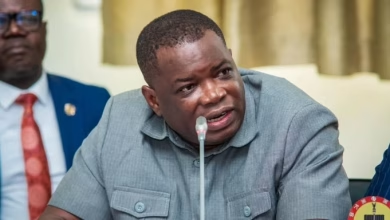
Energy policy analyst Kwadwo Nsafoah Poku has cautioned that ordinary consumers will bear the greatest hardship if the Public Utilities Regulatory Commission (PURC) approves the steep tariff increases proposed by the Electricity Company of Ghana (ECG) and the Ghana Water Company Limited (GWCL).
Speaking on Joy News’ PM Express, Mr. Poku acknowledged that while the utility providers may have valid reasons for their requests, the financial burden on households and businesses would be unsustainable.
“If you approach it strictly from a business standpoint, as many businesspeople do, you might be tempted to approve the figures line by line. But the reality is that the ultimate burden falls on consumers—many of whom simply can’t afford it,” he warned.
The ECG has requested a 225% increase in its Distribution Service Charge, citing the need to prevent financial collapse and maintain a reliable electricity supply. Meanwhile, GWCL is seeking a 280% hike, attributing the rise to increased production costs driven by illegal mining and water pollution.
Mr. Poku pointed out that consumers are already unknowingly subsidising water, highlighting inefficiencies in the current pricing model.
“From what I saw in GWCL’s presentation, the cost of producing water is significantly higher than what we pay per cubic meter. That means consumers are essentially subsidising water without realising it,” he said.
He further explained that the challenges facing ECG and GWCL are distinct but equally critical.
“ECG distributes electricity but struggles with revenue collection. GWCL, on the other hand, distributes water that’s very expensive to produce. So while their problems are different, they’re both serious,” he noted.
Mr. Poku emphasized that applying a strictly business-oriented approach to the issue would inevitably lead to cost transfers to the consumer—a model he believes is unsustainable.
“If I were operating purely as a businessman, I’d want to pass those costs on to the consumer. But in Ghana’s case, that just doesn’t add up,” he argued.
He concluded by reiterating the disconnect between actual production costs and the prices paid by consumers, particularly in the water sector.
“All of these requests might be justified, but at the end of the day, we’re dealing with a system where the numbers don’t align—one plus one doesn’t equal two,” he added.