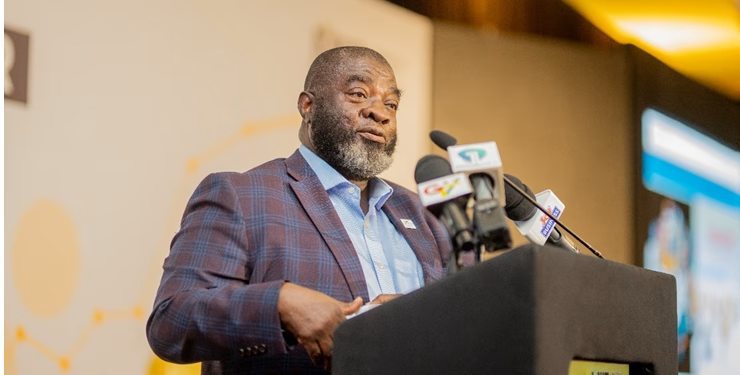
- David Ofosu-Dorte attributes Ghana’s ongoing public transport challenges to political interference and poor regulatory frameworks
- Political control has led to inefficiencies in scheduling and service quality, especially in urban areas
- The Ghana Road Transport Council has created a cartel-like structure, worsening transport sector inefficiencies
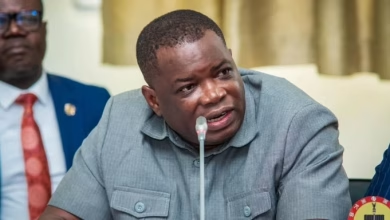
David Ofosu-Dorte, Senior Partner at AB & David Africa, has attributed Ghana’s ongoing public transport issues to excessive political interference and weak regulatory oversight over the years. His comments come amid a worsening transport crisis in Accra, where commuters often find themselves stuck in long queues, particularly during peak hours.
Speaking on the Citi Breakfast Show on Thursday, January 15, 2026, Mr. Ofosu-Dorte explained that political influence in the management and regulation of public transport has severely undermined efficiency, scheduling, and service quality, all of which have contributed to the current difficulties, especially in urban areas.
Tracing the issue back to the 1970s, he recalled that successive governments attempted to address public transport challenges by establishing state-backed institutions. In 1974, for instance, the government set up entities like the Omnibus Licensing Authority and the Winneba Services Authority, whose bus services eventually evolved into what is now known as Metro Mass Transit Limited.
Despite the introduction of these bus services, Mr. Ofosu-Dorte noted that the necessary regulatory framework was never fully implemented, and when there were changes in government, the sustainability of the system was undermined.
He also pointed out that under the Hilla Liman administration, the City Express was introduced to offer urban transport services. However, financial constraints later forced the company to pivot from its original intracity mandate to intercity operations, which diluted its effectiveness.
While acknowledging the role of state-led initiatives, Mr. Ofosu-Dorte also recognized the long-standing contribution of private transport operators, particularly unions like the Ghana Private Road Transport Union (GPRTU), PROTOA, and others, in keeping the transport system functional. He even mentioned that some private operators, such as King of Kings, once offered highly organized and punctual services.
Reflecting on his own experience, Mr. Ofosu-Dorte recalled that political divisions within the transport unions marked a turning point. He reminisced about his school days in the Western Region when he could rely on punctual bus services. However, he said the advent of political influence within the unions led to their fragmentation.
“As I was growing up, I could stand by the roadside at 7:15 a.m., and the bus would be there on time for me to get to school. When politics came in, the organization split,” he shared.
He further explained that the eventual merger of transport unions into the Ghana Road Transport Council led to the creation of a cartel, exacerbating inefficiencies within the sector. “Once the government consolidated these groups into the Ghana Road Transport Council, we essentially had a cartel on our hands, which made the situation worse,” he added.
Mr. Ofosu-Dorte also highlighted the importance of who controls transport terminals and transit stops as critical factors in the effective management of urban transport systems. “Two key elements for any urban transport service to function properly are who controls the terminals and the transit stops. Every vehicle needs a place for passengers to board and alight,” he explained.
He argued that handing control of terminals to the GPRTU led to a lack of competition and accountability, which in turn weakened the transport system. “At one point, we handed over control of the terminals to the GPRTU, and that’s when the problems really began. When a cartel controls the terminals, it’s difficult to improve service quality or stick to schedules,” he said.
Mr. Ofosu-Dorte emphasized that managing transit stops effectively is just as crucial, as they allow commuters to predict bus arrivals and know what type of buses to expect. He stressed that such predictability is vital for a functional urban transport system.