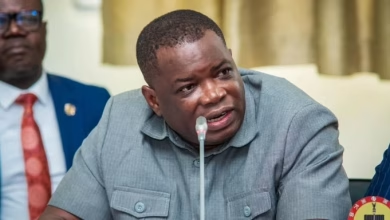

- Ghana’s President John Mahama remains outspoken, unafraid to challenge global powers
- At the U.N., Mahama denounced the Security Council’s “totalitarian guardianship” and declared: “The future is African”
- Ghana’s economy stabilised within six months of his return: inflation halved, cedi up 30%, youth jobs program launched
Just weeks earlier, Mahama’s Foreign Minister had arrived at the U.S. State Department, only to be confronted with an op-ed his boss had penned for the U.K. Guardian. In that piece, Mahama sharply rebuked then–U.S. President Donald Trump’s baseless claims of a “white genocide” in South Africa, calling Trump’s “unfounded attack” on South African President Cyril Ramaphosa during a heated Oval Office meeting “an insult to all Africans.”
“They asked him, ‘Did your President actually write this?’” Mahama recalls from his office in Accra’s Jubilee House. “He replied, ‘Yes—my President is a writer and likes to express himself.’ And they said, ‘Well, he’s President now. Can you ask him to put his pen down?’”
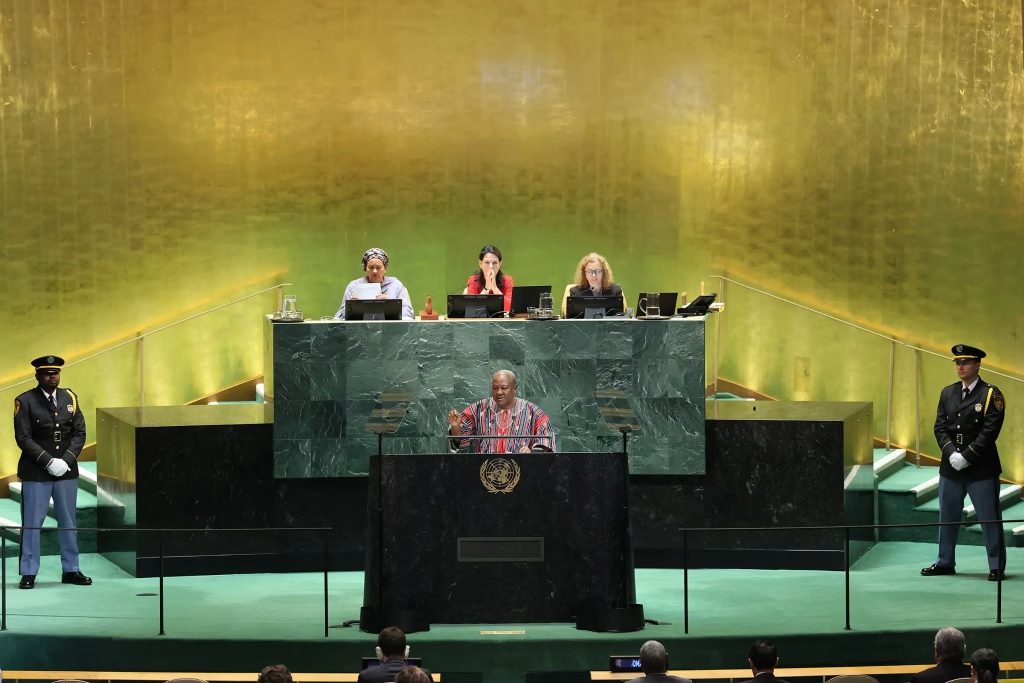
Even if Mahama ever does pause his writing, it’s hard to imagine him holding back his opinions. On Sept. 25, the 66-year-old leader used his speech at the U.N. General Assembly to accuse the Security Council of exercising “almost totalitarian guardianship over the rest of the world.” He demanded an African seat at the table—and the abolition of the veto power—before declaring, to loud applause, “The future is African!”
Grand words, perhaps, but hardly empty ones. By 2050, more than a quarter of the world’s people will come from Africa, including a third of those aged 15 to 24. The continent’s combined GDP, $2.6 trillion in 2020, is projected to soar to $29 trillion by mid-century. Africa also hosts three of the world’s 20 fastest-growing tech hubs, led by Lagos, Nigeria.
Still, Africa’s rise remains uneven, as Ghana’s own journey shows. Long seen as a beacon of stability and democracy, the nation of 34 million has faced serious economic headwinds. When Mahama returned to power in January for a second, nonconsecutive term, he inherited a country struggling with heavy debt, rising costs, and youth unemployment of nearly 39%.
Within six months, Mahama had steadied the economy—cutting inflation in half, strengthening the cedi by 30%, and launching a sweeping “Resetting Ghana” agenda. He introduced a 24-hour economy to keep businesses and government services running around the clock, eliminated burdensome taxes on online shopping and betting, and implemented a new code of conduct to curb corruption.
He also pledged free tuition for all first-year students at public universities and committed to distributing free menstrual products to school-aged girls. To tackle joblessness, he unveiled a plan to train one million coders within four years—fuel for Ghana’s budding tech sector.
“We must improve security so that people feel safe going to work and coming home,” Mahama says. “We know what our responsibilities are.”
But politics often turns on the unexpected—and a major shock was brewing. Less than three weeks after Mahama’s January 7 inauguration, the Trump Administration began dismantling USAID programs that had channelled $12.7 billion to sub-Saharan Africa, roughly 0.6% of the region’s GDP.
Analysts warned of dire consequences. The Institute of Security Studies in Pretoria estimated that 5.7 million more Africans could fall into extreme poverty within a year, while the Africa CDC projected up to four million additional deaths annually due to cuts in global aid budgets. South Africa alone could see 500,000 extra deaths from reduced HIV/AIDS funding over the next decade, according to the Desmond Tutu HIV Centre.
Ghana lost $156 million earmarked for public health, education, and governance initiatives. Still, Mahama insists the damage was manageable. “I told our Finance Minister to make adjustments—we’ve covered it in our budget,” he says. “We’re fine, but not so in some other countries. One of my colleagues told me USAID’s withdrawal shut down their school feeding program. For them, it’s devastating.”
For Mahama, the crisis marks a turning point. Africa, despite its abundant resources, continues to face trade barriers, poor market access, and underinvestment. The decline of foreign aid, he believes, could be a catalyst—forcing nations to innovate, cooperate, and build self-reliant economies. “Ghana will manage,” he says. “It teaches us to depend on ourselves.”
Mahama speaks with calm precision, his easy demeanor masking the boldness of his ideas—a fitting emblem of Africa’s growing confidence. Born in the small northwestern town of Damongo, Mahama was the son of a rice farmer and MP who served under Ghana’s first postcolonial leader, Kwame Nkrumah. After studying history at the University of Ghana, he taught high school before earning a postgraduate degree in social psychology in Moscow in 1988—an experience that shaped his conviction that every nation must chart its own path.
Before entering politics, he worked for the Japanese Embassy and Plan International. Elected to parliament in 1996, he rose through the ranks to become president in 2012. His first term, however, was rocky—marred by power shortages and corruption scandals, including the revelation that he had accepted a Ford SUV from a contractor. A probe cleared him of graft but ruled the gift improper. GDP growth fell from 9.3% to 2.1% before recovering to 8.1% in 2017, too late to save his presidency. His successor’s tenure was worse, leaving Ghana mired in debt and forced to default in 2022 on both domestic and foreign obligations.
Mahama’s swift turnaround since returning to power is striking—especially amid aid cuts. Critics have long said that aid breeds dependency. Though USAID once aimed to channel a quarter of its budget through local organizations, it never exceeded 10%, and last year that share fell. “Western contractors and NGOs got most of the money meant for Africa,” says Bright Simons of the Accra-based IMANI Centre for Policy and Education. “Africans never built real capacity.”
In effect, foreign aid disrupted the social contract. Governments answered to donors rather than taxpayers, weakening accountability and professionalism. The result: systemic corruption and capital flight. Each year, an estimated $88.6 billion—3.7% of Africa’s GDP—leaves the continent illicitly, according to the U.N.
“Aid makes policymakers lazy,” argues economist Dambisa Moyo in Dead Aid. “That’s why so many African leaders show little urgency in fixing their nations’ problems.”
That critique has become mainstream. Zambia’s President Hakainde Hichilema called U.S. aid cuts a “long overdue” wake-up call, while Rwanda’s Paul Kagame noted, “We can’t rely on generosity forever. Pain can teach us.” Mahama agrees the shift will have long-term benefits, even if the process is painful. Still, he’s frustrated by U.S. trade policy.
“One country can’t decide to act alone—slapping tariffs just to bring manufacturing back,” he says, shaking his head. “Those trade deals took years to negotiate under the WTO. This isn’t an effective way to do foreign policy.”
The implications for U.S. influence are uncertain. USAID was created in 1961 by President John F. Kennedy to counter Soviet expansion. Today, Washington faces a similar rivalry with China, whose presence in Africa is expanding rapidly. Mahama warns that America’s isolationism “erodes U.S. soft power and opens the door for others.”
It’s not just China making inroads. Gulf states, India, and Europe are deepening ties as well. In August, London Mayor Sadiq Khan led the first African trade mission by a holder of his office, visiting Ghana, Nigeria, and South Africa. “When Trump shuts out international students, the U.K. should welcome them,” he told TIME in Accra.
The U.S., however, insists it isn’t retreating, pointing to over 100 American companies active in Ghana across sectors from energy to healthcare. In July, Google opened an AI Community Centre in Accra alongside $37 million in regional funding. Rolf Olson, the U.S. Embassy’s chargé d’affaires, says Washington stands ready to partner with Ghana in tackling corruption and illegal gold mining—“activities often backed by foreign actors, including Chinese firms.”
Mahama is diplomatic but firm. “The Chinese government has been supportive,” he says. “I don’t like to single them out.” He adds that the U.S. fixation on Beijing is “surprising.” “If you’re worried about China, that’s when you need allies—Canada, Mexico, the EU. But if you’re threatening everyone with tariffs, it’s hard to see the goal. Cooperation would be better than these growing tensions.”
Unlike China’s infrastructure-heavy approach, U.S. aid traditionally emphasized governance, education, and human rights. But as aid vanishes, Africa must find new ways to fund its own development—without falling back into dependency.
Ghana offers examples: new refineries, expanded gold regulation, and surging exports. Across the continent, governments are demanding that foreign investors process raw materials locally to capture more value. As Khan puts it, “We need to move from a paternalistic ‘helping hand’ to a partnership based on trade.”
Technology and environmental markets could further unlock Africa’s wealth. The continent holds 60% of the world’s uncultivated arable land and immense carbon-sequestration potential, yet accounts for just 16% of the global carbon credit market. Nations like Kenya, Gabon, and Tanzania are pioneering carbon credit schemes, with Ghana following suit. Mahama says his administration has already reclaimed nine of 44 forest reserves seized by illegal miners and launched a reforestation program.
He also sees promise in blockchain. Tokenizing natural resources—turning gold, diamonds, or forests into digital assets—could open new streams of capital. But the ultimate goal, he insists, is diversification: “We want to move beyond mining and agriculture into agro-processing, manufacturing, and digital services.”
Africa’s future, he argues, depends not just on exports to the West but on trade within its own borders. The African Continental Free Trade Area, launched in 2018, creates a $3 trillion market of 1.3 billion people. “It expands us far beyond Ghana’s 34 million,” says Mahama, noting India’s recent offer to share pharmaceutical technology.
Yet investment is essential. Africa’s 20 sovereign wealth funds total just $97 billion—less than 1% of the global total—and its governments pay up to four times the interest rates of wealthier nations. The Tony Blair Institute proposes a $100 billion debt-swap program to ease the burden; refinancing at lower rates could free billions for healthcare, education, and infrastructure.
Still, Mahama remains philosophical about the new world order. “Since World War II, global progress has come through interdependence and multilateralism,” he says. “Now, unilateralism seems to be the trend. But no one benefits from that—because the world only moves forward together.”