- Tax relief for businesses: Government abolishes the COVID-19 levy, cuts VAT from 21.9% to 20%, and raises the registration threshold to GH₵750,000.
- Boost for investment: VAT on mineral exploration removed; local textile zero-rating extended to 2028 to protect jobs.
- Modernised tax system: Digital VAT monitoring, reward schemes, and new port systems to enhance transparency and curb revenue leakages.
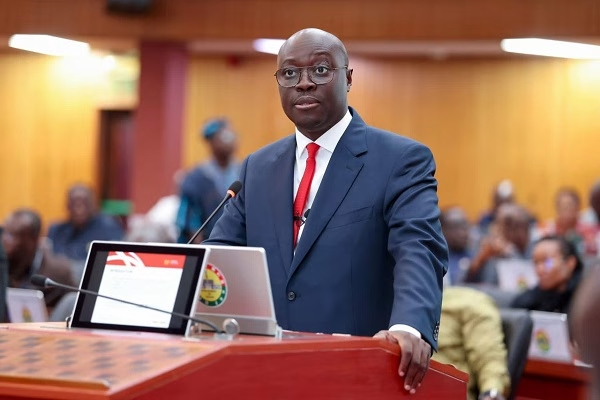
Finance Minister Dr. Cassiel Ato Forson has unveiled a comprehensive package of tax reforms under the 2026 Budget, aimed at building a fairer, simpler, and more business-friendly fiscal environment.
Presenting the budget to Parliament, Dr. Forson described the reforms as a turning point in Ghana’s tax administration, crafted to ease compliance for businesses while strengthening domestic revenue mobilisation.
“This is not just a tax reform. It is a step toward a more just, predictable, and business-friendly economy,”
Dr. Forson stated. “It honours our pledge to lighten the load on honest taxpayers while building a stronger foundation for national development.”
Key Reforms Announced
The 2026 Budget abolishes the COVID-19 Health Recovery Levy, reduces the effective VAT rate from 21.9% to 20%, and raises the VAT registration threshold from GH₵200,000 to GH₵750,000 — measures designed to ease the burden on small and medium enterprises (SMEs).
According to the Finance Minister, these steps will return an estimated GH₵5.7 billion to businesses and households while enhancing Ghana’s competitiveness in the subregion.
In addition, VAT on mineral exploration and reconnaissance has been scrapped to attract fresh investment in the extractive sector, and the zero-rating for locally manufactured textiles has been extended to 2028 to protect jobs in the local industry.
Digitisation and Transparency Measures
To modernise tax collection, the government will introduce digital VAT monitoring systems, fiscal electronic devices, and a VAT reward scheme to promote transparency and voluntary compliance.
Beyond VAT, the Ministry of Finance will embark on a comprehensive review of key tax laws — including the Income Tax Act, Customs Act, and Excise Duty Act — to align Ghana’s fiscal framework with global best practices.
“We must move from patchwork reforms to a coherent, modern framework,”
Dr. Forson noted. “Our goal is to ensure Ghana’s tax system keeps pace with changing business realities, protects our tax base, and rewards compliance.”
Curbing Smuggling and Revenue Leakages
The Minister also announced plans to deploy advanced monitoring systems at the ports to tackle smuggling, under-invoicing, and misclassification — persistent issues that have drained public revenue for years.
These measures, he explained, are expected to close long-standing loopholes, enhance customs efficiency, and strengthen state capacity to fund development priorities.
“Through these reforms, we are not merely raising revenue,” Dr. Forson emphasised.
“We are rebuilding trust between citizens and the state, ensuring that every cedi collected is used to build the Ghana we want.”
Sustaining Growth Through Fiscal Discipline
The 2026 tax reform package forms a central pillar of the government’s fiscal consolidation agenda, designed to maintain macroeconomic stability while stimulating private sector growth and job creation.
By simplifying taxes and promoting fairness, the reforms signal a renewed commitment to a growth-oriented and transparent economy—one that rewards compliance and supports enterprise.