The Centre for Policy Scrutiny (CPS) has warned that the government’s ambitious plan to increase capital spending by 141% in 2026 may be unsustainable unless revenue collection improves.
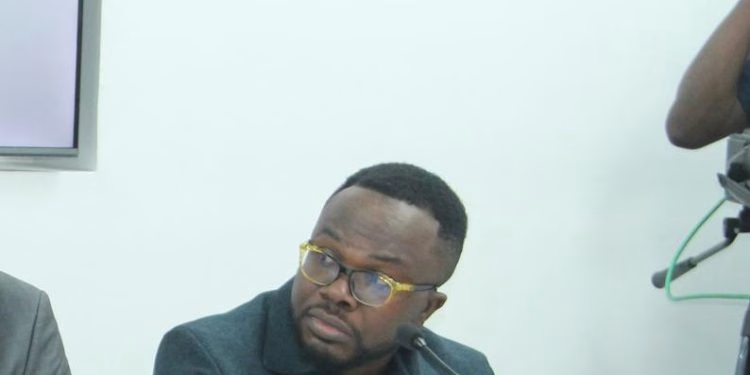
Dr. Prince Adjei, a policy fellow at the Centre, emphasized that the success of the 2026 Budget hinges on addressing long-standing leakages in the tax system.
He noted that the proposed surge in expenditure will only be credible if the Ghana Revenue Authority (GRA) is adequately resourced to implement new revenue measures. “Make the 2026 revenue measures more credible by equipping the GRA to deploy technology and plug gaps, while intensifying enforcement in high-leakage areas like customs,” he stressed.
Dr. Adjei also cautioned that increased spending must not come at the expense of efficiency. He called for rigorous programme and project planning, alongside transparent and cost-effective procurement, to ensure value for money.
He added that the public sector should institutionalize ongoing evaluation of government programmes to ensure they are effectively managed and adjusted to achieve intended outcomes.
The policy fellow further recommended growth-oriented reforms, urging the government to adopt innovative approaches that balance stability and growth, while also encouraging greater private-sector investment to complement public spending.
With the services sector continuing to dominate Ghana’s economy, Dr. Adjei highlighted the importance of investing in human capital, noting that workers will need specialized skills to take advantage of opportunities in the expanding sector.
For the 2026 fiscal year, total expenditure is projected at GH¢302.5 billion (18.9% of GDP), while total revenue and grants are expected to reach GH¢268.1 billion.
The CPS therefore recommends that the government prioritize education and skills development to align workforce talent with industry needs.