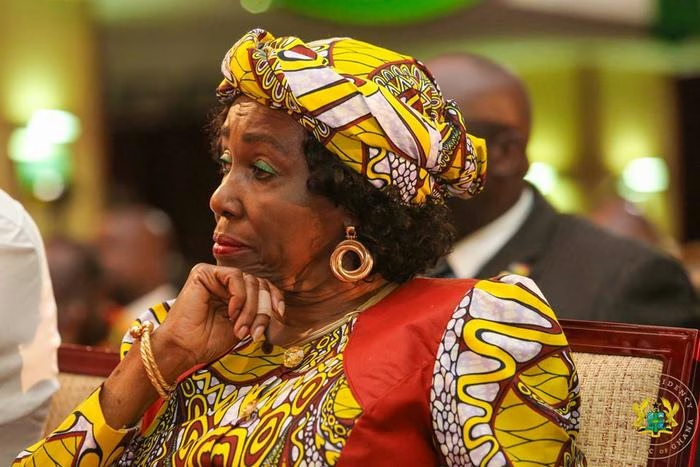
- Nana Konadu, known as Ghana’s ‘Iron Lady,’ passed on October 23, 2025
- She served as First Lady for nearly 20 years, the longest in Ghana’s history
- Founded the impactful 31st December Women’s Movement in 1982, empowering millions of women
The passing of Nana Konadu Agyeman-Rawlings today, Thursday, October 23, marks the end of a remarkable era in Ghana’s political and social history.
Often hailed as the ‘Iron Lady’ of Ghanaian politics, Nana Konadu was known for her fierce activism during the 1980s and 1990s. She also made history as the first woman to run for president in Ghana, among numerous achievements that distinguished her from her peers.
More than just a First Lady, she was a relentless advocate for women’s rights, a trailblazer who continuously challenged the political status quo, and a powerful figure who left an indelible mark as one of the most influential women in Ghana’s post-independence era.
The Longest Serving First Lady
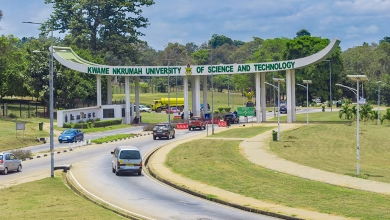
Born on November 17, 1948, in Cape Coast, Central Region, Nana Konadu Agyeman attended Achimota School, where she met her future husband, Flight Lieutenant Jerry John Rawlings. She pursued Art and Textiles at Kwame Nkrumah University of Science and Technology (KNUST) and earned a diploma in Interior Design from the London College of Arts in 1975. Later, she also attained qualifications in Advanced Personnel Management and Development from GIMPA, reflecting her strong intellectual drive.
Her marriage to Rawlings in 1977 marked the beginning of a life intertwined with Ghana’s political journey. She served as First Lady during two key periods: briefly in 1979 during the Armed Forces Revolutionary Council (AFRC) era and then continuously from December 31, 1981, to January 7, 2001, covering the military Provisional National Defence Council (PNDC) rule and two civilian terms in the Fourth Republic. This makes her the longest-serving First Lady in Ghana’s history, giving her an unparalleled platform to promote social change.
Champion of Women’s Empowerment: The 31st December Women’s Movement
Nana Konadu is best remembered as the founder and president of the 31st December Women’s Movement (31st DWM), established in 1982. Far from a symbolic organization, the 31st DWM was a dynamic grassroots movement dedicated to empowering women, particularly in rural areas, with the firm belief that women held the key to breaking the cycle of poverty.
The movement achieved significant milestones:
- Grassroots Mobilization: It brought together around two million women nationwide, encouraging their active participation in community and national decision-making. The movement established over 870 pre-schools, freeing women to engage in economic activities.
- Economic Empowerment: It supported numerous income-generating and village-level projects, promoting savings for community development.
- Education and Health: The 31st DWM implemented adult literacy programs and public health initiatives focused on nutrition and immunization.
- Legal and Political Reforms: Nana Konadu was instrumental in championing legal changes, including the Intestate Succession Law (PNDCL 111), which significantly improved inheritance rights for widows and children, breaking away from traditional barriers. She also played a key role in Ghana becoming the first country to adopt the United Nations Convention on the Rights of the Child (UNCRC) in 1991.
Reflecting on the movement’s impact, she once said, “Before December 31, 1981, women had no influence in law or politics… I see from their newfound confidence that we have broken through that thick wall,” underscoring the 31st DWM’s mission to empower women.
A Tenacious Political Trailblazer
After her tenure as First Lady, Nana Konadu remained a formidable and unwavering political figure. Her political style has been described by some analysts as ‘femocracy’—a fusion of feminist advocacy and political authority.
In 2009, she became the First Vice Chairperson of the National Democratic Congress (NDC), the party co-founded by her husband. However, her political journey with the NDC was turbulent, culminating in her unexpected challenge to the late President John Atta Mills for the party’s presidential candidacy in 2011, which sent shockwaves through Ghanaian politics.
Her final bold move was founding the National Democratic Party (NDP). In 2016, she made history as the first Ghanaian woman to run for president. Though she garnered only 0.16% of the vote, her candidacy shattered political glass ceilings and inspired generations of women leaders.
Nana Konadu Agyeman-Rawlings’ life was defined by resilience, conviction, and an unshakeable belief in the potential of Ghanaian women to shape their country’s political and economic future.
She leaves behind a legacy of tireless activism, courageous political challenges, and empowerment that has touched millions of women across Ghana and the African continent. Truly, she was a pioneer who carved her own path through the complexities of Ghanaian politics.