- Denmark and Greenland maintain a “fundamental disagreement” with Trump over U.S. control of Greenland
- A working group will explore solutions to address U.S. security concerns while respecting Danish sovereignty
- Trump argues Greenland is vital for U.S. national security and cites potential threats from China and Russia
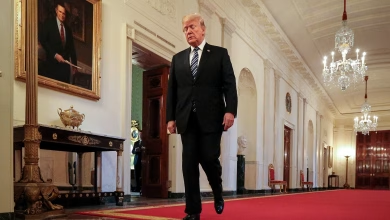
A senior Danish official said Wednesday that a “fundamental disagreement” over Greenland remains with former President Donald Trump following high-profile White House talks with Vice President JD Vance and Secretary of State Marco Rubio.
Despite the impasse, both sides agreed to establish a working group to explore ways to address differences, as Trump continued to push for U.S. control over the semiautonomous territory of NATO ally Denmark.
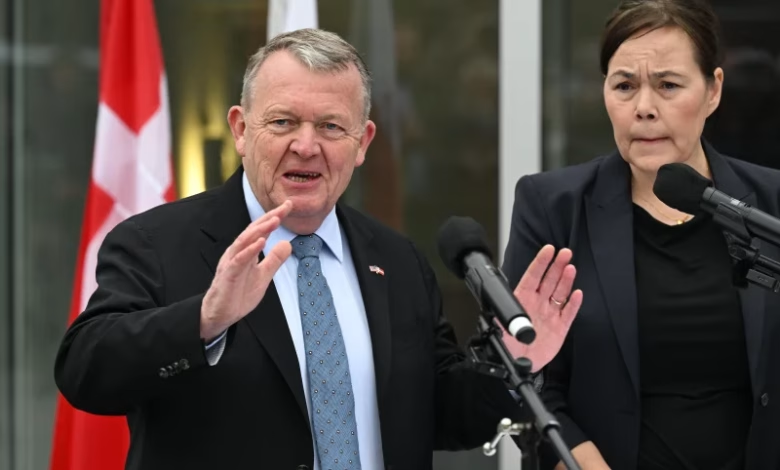
Danish Foreign Minister Lars Løkke Rasmussen, speaking after the meeting alongside Greenland’s Foreign Minister Vivian Motzfeldt, emphasized that the working group would focus on American security concerns while respecting Denmark’s “red lines.” He noted, however, that Trump maintains a strong desire to assert U.S. authority over Greenland.
Trump has argued that NATO should back the U.S. in acquiring the world’s largest island, claiming that China and Russia have strategic interests there. Denmark, in response, announced plans to strengthen its military presence in the Arctic and North Atlantic.
In a brief Oval Office exchange with reporters after the talks, Trump reiterated his commitment to acquiring Greenland. “We need Greenland for national security,” he said, adding, “We’ll see how it all works out. I think something will work out.” Earlier, Trump had tweeted that “NATO becomes far more formidable and effective with Greenland in the hands of the UNITED STATES” and described anything less as “unacceptable.”
NATO Secretary General Mark Rutte has sought to maintain distance from the dispute, as other alliance members watch warily amid Trump’s assertive approach toward Denmark.
Rasmussen and Motzfeldt expressed cautious optimism that the talks could lead to dialogue and potential cooperation with the U.S., without relinquishing Greenlandic sovereignty. “We have shown where our limits are, and from there, I think it will be very good to look forward,” Motzfeldt said.
Denmark boosts Arctic security
In Copenhagen, Danish Defense Minister Troels Lund Poulsen announced an expansion of Denmark’s “military presence and exercise activity” in the Arctic and North Atlantic, in collaboration with allies. He stressed the need for heightened readiness in an unpredictable security environment, confirming that aircraft, ships, and soldiers—including personnel from other NATO countries—would be deployed around Greenland.
While the increased deployments are relatively modest, Germany is sending 13 personnel this week to assess potential military contributions, Sweden is sending an unspecified number of personnel for exercises, and Norway is sending two military personnel to map out cooperation, according to defense officials. NATO is also reviewing ways to collectively strengthen its Arctic presence, emphasizing the High North as a strategic priority.
Greenlanders push back against U.S. takeover
Strategically located, Greenland is becoming increasingly important as melting ice opens trade routes to Asia and exposes untapped mineral resources. Trump has also framed Greenland as vital for U.S. missile defense and national security, citing Russian and Chinese activity in the region.
However, experts and residents dispute these claims. Locals report seeing little evidence of foreign encroachment. “The only Chinese I see is when I go to the fast food market,” said heating engineer Lars Vintner. Others, like 21-year-old Maya Martinsen, argue that Trump’s interest is more about natural resources than security.
Denmark has clarified that while the U.S., party to a 1951 treaty, can expand its military bases with Danish and Greenlandic consent, Greenland will remain under Danish sovereignty.
Rasmussen and Motzfeldt planned further meetings with U.S. lawmakers from the Arctic Caucus in Washington and Copenhagen. Both emphasized that ongoing dialogue is essential, even amid disagreements, to balance U.S. security concerns with Denmark’s territorial integrity and Greenlanders’ self-determination. “It is in everybody’s interest — even though we disagree — to explore whether it is possible to accommodate concerns while respecting the integrity of the Danish kingdom and the Greenlandic people,” Rasmussen said.