- ECOWAS Court denies former Chief Justice Torkonoo’s request for temporary prohibition orders
- Government’s argument that the Court lacks jurisdiction dismissed as “misplaced"
- Court says Torkonoo showed prima facie human rights concerns but failed to prove urgency
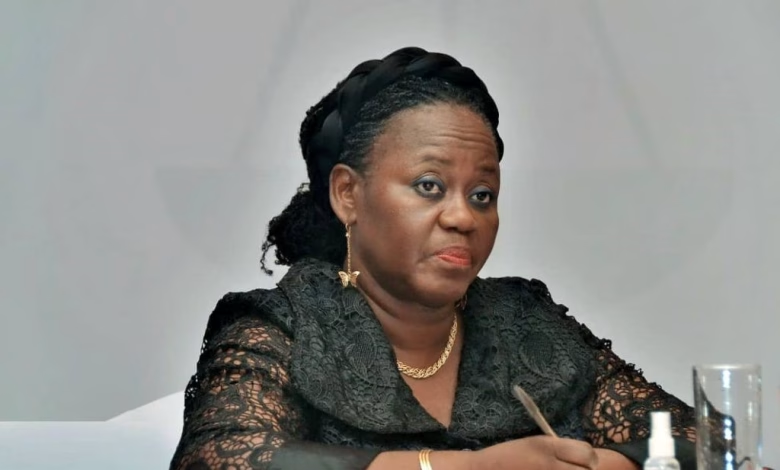
The ECOWAS Court of Justice has rejected former Chief Justice Gertrude Torkonoo’s request for interim orders to halt the work of the committee that investigated her removal from office.
The Court also dismissed a preliminary objection from the Government of Ghana, which had argued that the regional court lacked jurisdiction to hear the case.
Justice Torkonoo filed the application after the President set up a committee, chaired by Justice Gabriel Scott Pwamang, to investigate matters that culminated in her removal and the subsequent swearing-in of her successor, Chief Justice Paul Baffoe-Bonnie.
In its ruling on Wednesday, November 19, 2025, the ECOWAS Court acknowledged that the former Chief Justice had presented a prima facie case alleging human rights violations. However, it held that she failed to prove the urgency necessary for the issuance of temporary orders to stop the committee’s work.
The judges highlighted that although she was suspended on April 22, 2025, and was aware of the ongoing processes, she waited three months before filing her motion—undermining claims of imminent or irreparable harm.
Her request for prohibition orders was therefore denied.
The Court also rejected an objection from Ghana’s Attorney General, who argued that the case was sub judice because similar issues were before a Ghanaian court. The ECOWAS Court found the argument “misplaced,” stating that the application before it concerns alleged human rights violations during the suspension and removal process, not an attempt to overturn decisions of a national court.
The judges clarified that the sub judice rule applies only when a case is awaiting judgment elsewhere, not simply because two matters share factual similarities.
The Court concluded that it has jurisdiction to hear the substantive case, ruled the application admissible, and directed the Attorney General to file a formal response.