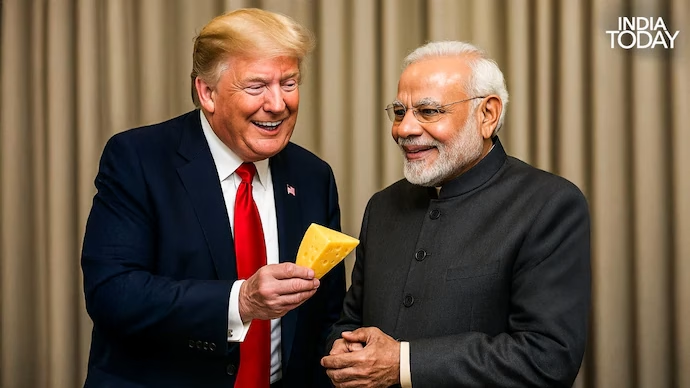
- India and the US hold exploratory trade discussions in New Delhi
- US team led by Brendan Lynch; India represented by Rajesh Agrawal
- India defends Russian oil purchases; calls US tariffs “unfair”
India and the United States are holding a day of trade discussions, raising hopes that negotiations on a long-delayed bilateral trade agreement may soon resume.
A U.S. delegation led by trade negotiator Brendan Lynch has arrived in New Delhi for talks with officials from India’s Commerce Ministry.
However, Indian officials have emphasized that this meeting is not the official restart of formal negotiations. Describing the discussions as exploratory, they said the goal is to assess how both sides might move forward toward a possible agreement.
Trade talks had come to a halt after former U.S. President Donald Trump imposed a steep 50% tariff on several Indian exports. The move, partly in response to India’s continued purchase of Russian oil and arms, was met with sharp criticism from Delhi, which defended its energy procurement as essential for domestic needs and labeled the tariffs “unfair.”
The tariffs, combined with harsh rhetoric from Trump and key administration officials, strained relations between the two countries, despite being long-time strategic partners.
India, a major exporter of goods such as textiles, shrimp, and gems to the U.S., has already felt the economic impact of these trade barriers, with factories reporting job losses and production slowdowns.
As a result, Tuesday’s meeting is being watched closely by both industry and policymakers.
“This is not a formal negotiation round,” clarified Rajesh Agrawal, who is representing India in the talks. “But it is definitely a conversation about how we can work toward a trade agreement with the U.S.”
A previous round of talks was abruptly canceled last month following the tariff announcement and India’s refusal to cease purchases of Russian oil.
However, in recent days, there have been signs of a potential thaw. U.S. officials have adopted a more conciliatory tone, and India has confirmed its willingness to remain engaged in discussions.
On Monday, U.S. trade adviser Peter Navarro told CNBC, “India is coming to the table. We’ll see how this plays out.” Navarro, a consistent critic of India, has controversially referred to the war in Ukraine as “Modi’s war” due to India’s continued dealings with Russia.
He also alluded to a recent social media exchange between Trump and Indian Prime Minister Narendra Modi. Trump claimed the two nations were “continuing negotiations to address trade barriers,” while Modi echoed the sentiment, describing the U.S. and India as “close friends and natural partners.”
Sergio Gor, Trump’s nominee for U.S. ambassador to India, expressed optimism that a deal could be reached soon. “We’re not that far apart. They’re negotiating the fine print,” he said during a Senate confirmation hearing last week.
Despite the renewed optimism, major sticking points remain. Chief among them are agriculture and dairy—sectors that Washington has long sought greater access to, viewing India’s massive domestic market as a huge economic opportunity.
India, however, has remained steadfast in protecting its farm sector, citing food security and the livelihoods of millions of small-scale farmers.
Last week, U.S. Commerce Secretary Howard Lutnick reiterated his frustration, questioning why a country of 1.4 billion people wouldn’t “buy one bushel of U.S. corn.”
Indian analysts argue that opening up the agricultural sector to U.S. imports under pressure would compromise national sovereignty and endanger food security.
While both sides appear ready to engage, the path to a comprehensive trade agreement will depend on whether they can bridge these deep-rooted differences.